
Asus P6T7 WS SuperComputer
5.0Editor score
Supports 3-Way SLI and CrossFireX
Dual Gigabit LAN Controllers Included
12 USB 2.0 Ports Available
This guide compares the top Lga 1366 Motherboard options for enthusiasts seeking powerful performance and reliable legacy support for their desktop systems.
Choosing the right Lga 1366 Motherboard is essential for building a powerful legacy system that supports high-performance Intel Core i7 processors and triple channel memory configurations for demanding workloads.
We have carefully analyzed ten distinct models based on their chipset reliability, expansion slot configurations, power delivery phases, and connectivity options to ensure you find the best match for your specific desktop needs.
Each pick in this list highlights unique strengths such as overclocking potential, workstation stability, or budget-friendly pricing, but remember that availability and pricing can change rapidly for these older platform components.
5.0Editor score

4.0Editor score
The following table provides a side-by-side technical comparison of all ten reviewed boards so you can quickly identify which model offers the specific features you need for your build.


The ASUS P6X58D Premium stands out as a top-tier choice for enthusiasts looking to maximize their Lga 1366 platform potential with robust power delivery and modern connectivity features.
We may earn a commission when you buy through this link, at no additional cost to you.
Its 16+2 phase power design ensures stable power for high-demand CPUs while the included USB 3.0 and SATA 6Gb/s support provides significantly faster data transfer rates than older standards.
While it lacks some modern connectivity options typical of newer boards the Stack Cool 3+ fanless heat dissipation offers silent operation and effective thermal management under heavy computational loads.
This board is ideal for users seeking a reliable high-performance workstation or gaming rig that balances legacy compatibility with enhanced storage and peripheral speeds.
The 16+2 phase power design uses high quality components to deliver consistent voltage to the CPU which is critical for maintaining stability during intensive multitasking or overclocking scenarios.
The Stack Cool 3+ fanless solution utilizes a heat-pipe design to dissipate heat effectively without noise which benefits users who prioritize a quiet computing environment.
We may earn a commission when you buy through this link, at no additional cost to you.
The Asus P6T7 WS SuperComputer is a powerhouse designed for professional workstations that require maximum expandability and multi GPU rendering capabilities for complex computing tasks.
We may earn a commission when you buy through this link, at no additional cost to you.
Its unique chipset configuration supports 3-Way SLI and CrossFireX allowing users to link multiple graphics cards for significant performance boosts in 3D rendering and scientific simulations.
The inclusion of two Realtek Gigabit LAN controllers with Teaming Technology provides robust network redundancy and speed which is essential for server or high-throughput network environments.
If you need a board that can handle extensive parallel processing and multiple high-end peripherals this model offers the highest tier of connectivity and stability in the Lga 1366 ecosystem.
Support for 3-Way SLI and CrossFireX means users can attach up to three graphics cards for parallel processing which is ideal for professional 3D modeling and video editing workflows.
Dual gigabit LAN ports with Teaming Technology allow users to combine bandwidth or provide failover protection ensuring consistent network performance during critical data transfers.
We may earn a commission when you buy through this link, at no additional cost to you.
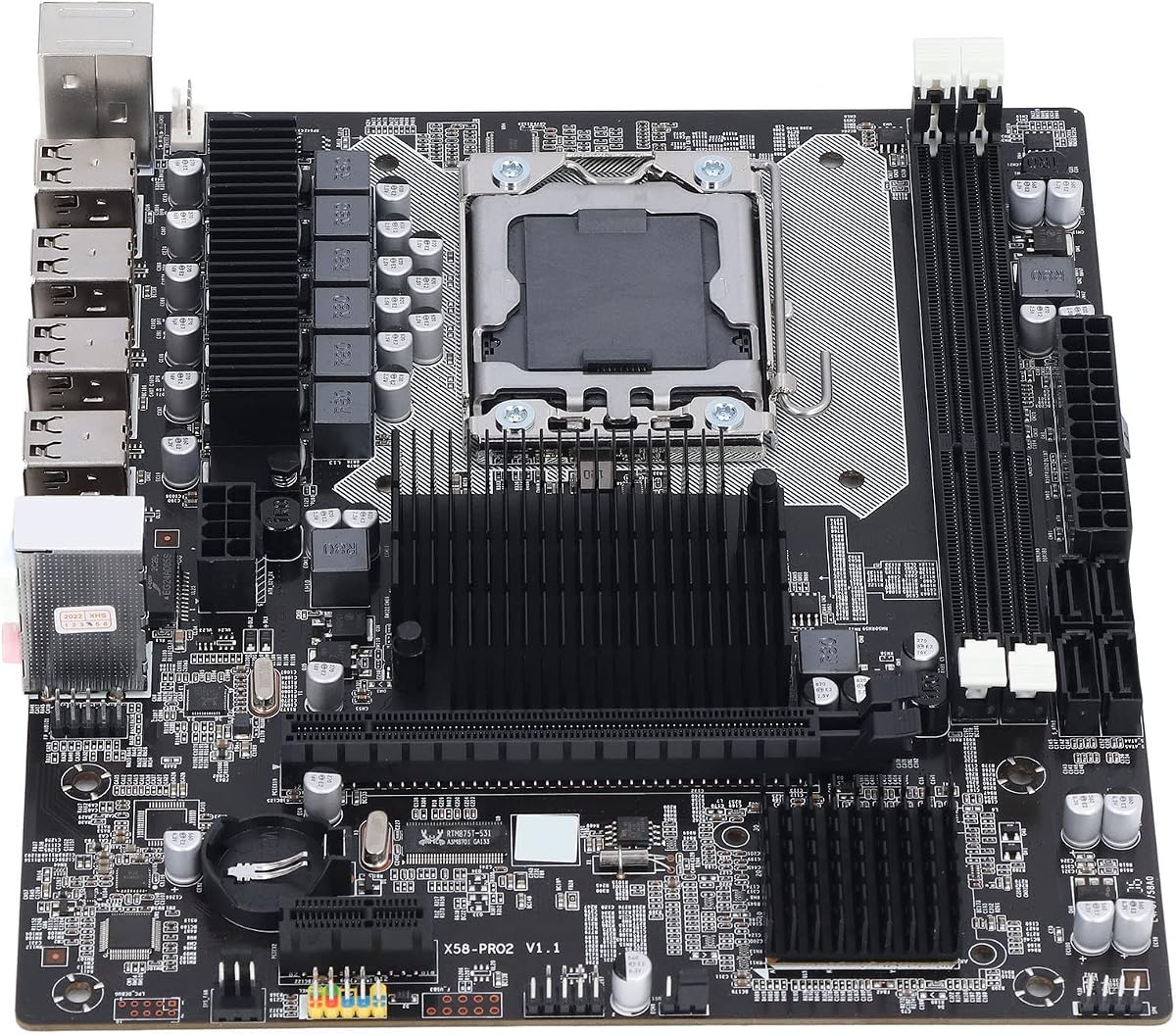
The X58 Gaming Motherboard provides a highly affordable entry point for those looking to assemble a legacy Lga 1366 system without breaking the bank on legacy components.
We may earn a commission when you buy through this link, at no additional cost to you.
It supports both ECC and non-ECC memory which gives users the flexibility to choose between stability focused workstation configurations or cost-effective gaming builds depending on their specific needs.
The use of all solid capacitors ensures a stable power delivery environment which is crucial for maintaining system longevity even when the board is subjected to extended periods of high usage.
For budget conscious builders who need basic functionality and support for older CPUs this board offers the essential features required to get a reliable desktop PC up and running.
Support for both ECC and non-ECC memory allows users to prioritize stability for data-intensive tasks or save money by using standard desktop memory modules for general use.
The inclusion of standard 8-Pin and 24-Pin power connectors ensures compatibility with most ATX power supplies making setup straightforward for DIY enthusiasts.
We may earn a commission when you buy through this link, at no additional cost to you.
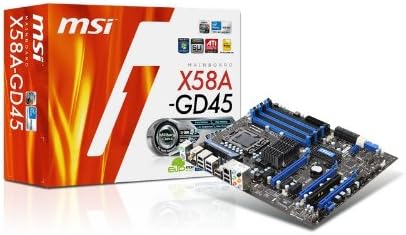
The MSI X58A-GD45 offers a compelling mix of legacy support and faster data transfer capabilities making it a strong candidate for users who need to connect high-speed storage devices.
We may earn a commission when you buy through this link, at no additional cost to you.
Its support for next-generation SATAIII up to 6Gbps bandwidth doubles the data transfer rate of older SATAII standards which significantly improves load times for large files and system boot speeds.
The revolutionary SuperSpeed USB 3.0 interface offers speeds ten times faster than USB 2.0 allowing for quicker file transfers between the PC and external storage devices or peripherals.
Users looking for a stable cooling focused motherboard that balances efficient power usage with modern data speeds will find this MSI model to be a reliable choice for their system.
SATAIII support up to 6Gbps and USB 3.0 provide a substantial boost in data throughput compared to previous generations which is vital for users working with large media files.
APS Active Phase Switching dynamically controls power demand which reduces energy waste and heat generation while maintaining stable performance under varying system loads.
We may earn a commission when you buy through this link, at no additional cost to you.
The Dx58So Extreme Series is designed specifically for users who require a robust desktop platform capable of handling older high-end processors with stable and predictable performance characteristics.
We may earn a commission when you buy through this link, at no additional cost to you.
As part of the Extreme Series this board focuses on providing a reliable foundation for legacy builds ensuring that the Core i7 processors can operate at peak efficiency without system instability.
While it may not offer the latest USB or SATA standards found on newer hardware it delivers the essential connectivity and power delivery required for a dedicated desktop PC environment.
This board is particularly useful for those maintaining specialized industrial or legacy systems where compatibility with older CPU generations is more critical than having the newest peripheral interfaces.
The board is optimized to provide a stable foundation for older Intel Core i7 processors ensuring consistent performance for specialized tasks that rely on legacy architecture.
Adhering to the standard ATX form factor ensures that this board will fit in most mid to full tower cases making upgrades and maintenance easier for users.
We may earn a commission when you buy through this link, at no additional cost to you.
The ASUS P6X58D-E distinguishes itself with a high count of connectivity options including multiple USB ports and SATA3 support which makes it ideal for users with many external peripherals.
We may earn a commission when you buy through this link, at no additional cost to you.
It supports Quad-GPU CrossFireX and nVidia 3-Way SLI Technology providing significant graphics power for users who need to render complex scenes or run multiple high resolution displays simultaneously.
The board features six SATA2 ports plus two SATA3 ports allowing for extensive storage expansion which is beneficial for media servers or workstation setups requiring large local storage arrays.
For builders who need a balance of legacy CPU support and modern connectivity interfaces this board offers a comprehensive package of features that cover most general computing needs effectively.
With eight total SATA ports including two SATA3 connections users can connect multiple drives for RAID arrays or large scale storage without needing additional expansion cards.
Support for Quad-GPU CrossFireX and 3-Way SLI allows for massive graphics scalability which is essential for high-end gaming or professional 3D rendering tasks.
We may earn a commission when you buy through this link, at no additional cost to you.
The Supermicro X8STI brings server grade reliability to the desktop Lga 1366 platform making it a perfect choice for small office servers or heavy workstation tasks.
We may earn a commission when you buy through this link, at no additional cost to you.
It includes dual Intel 82574L Gigabit Ethernet controllers which provide robust networking performance and redundancy crucial for machines that need to stay online continuously.
The integrated Matrox G200eW Graphic Controller ensures stable basic display output which is helpful for headless server setups or systems where dedicated graphics are not immediately needed.
Users prioritizing stability and network performance over gaming features will find this board offers the build quality and component selection necessary for professional computing environments.
Dual Intel Gigabit Ethernet controllers ensure high speed data transfer and network redundancy which is vital for small business servers or data intensive workstations.
The onboard Matrox controller provides reliable display output for systems that do not require dedicated graphics cards reducing power consumption and component count.
We may earn a commission when you buy through this link, at no additional cost to you.
The Supermicro X8DTN+ is a specialized EATX motherboard designed for dual socket configurations allowing users to install two Xeon processors for maximum computational power.
We may earn a commission when you buy through this link, at no additional cost to you.
It supports up to 144GB of ECC Registered DDR3 memory which provides immense capacity for virtualization heavy database tasks or other memory-intensive professional applications.
The Intel 5520 chipset enables high bandwidth communication between dual CPUs which is essential for tasks that require parallel processing capabilities across multiple cores and processors.
This board is best suited for advanced users or IT professionals who need to build a high performance server or workstation that demands multi-processor power and massive memory capacity.
Support for dual Intel Xeon processors allows for significant processing power scalability which is ideal for virtualization or server environments needing high throughput.
The ability to support up to 144GB of ECC Registered memory ensures that memory-heavy applications run smoothly without bottlenecks or capacity limits.
We may earn a commission when you buy through this link, at no additional cost to you.
The Asus P6T Deluxe V2 is a mainstream board that provides the standard features expected from an X58 platform including triple channel memory and support for Core i7 processors.
We may earn a commission when you buy through this link, at no additional cost to you.
It features a standard ATX form factor which fits in most mid to full tower cases ensuring that it is a versatile option for a wide variety of existing desktop chassis.
While it may lack some of the specialized features of higher end models it delivers solid performance for general computing and gaming tasks without requiring complex setup procedures.
Users looking for a straightforward and reliable build experience will appreciate the straightforward layout and broad compatibility of this board with legacy CPU and memory options.
The standard ATX form factor ensures easy installation into common desktop cases which simplifies the build process for users upgrading from older systems.
Broad support for Core i7 processors and standard DDR3 modules makes this board a safe choice for general users who need reliable performance for daily computing tasks.
We may earn a commission when you buy through this link, at no additional cost to you.
The Intel DX58SO Extreme Series offers a native Intel chipset experience which often provides better stability for Intel specific features compared to third party implementations of the X58 chipset.
We may earn a commission when you buy through this link, at no additional cost to you.
It supports up to 16 GB of DDR3 system memory which is sufficient for most general desktop and gaming use cases without needing excessive memory capacity that adds cost.
The board includes twelve USB ports total providing ample connectivity for keyboards mice webcams and storage drives without requiring extra hub expansions for most users.
For users who prefer a clean straightforward board with strong audio features and native support for Intel technologies this model provides a reliable foundation for a balanced system build.
Being an Intel branded board with a native chipset often results in better compatibility and stability for features like Turbo Boost and integrated memory controllers.
With twelve USB ports available users can connect multiple peripherals simultaneously without needing to invest in external USB hubs for a fully connected desktop setup.
We may earn a commission when you buy through this link, at no additional cost to you.
Selecting the right motherboard for an Lga 1366 system requires evaluating specific technical capabilities that match your usage needs and budget constraints.
The Intel X58 chipset is the primary standard for this platform and ensures support for QuickPath Interconnect which is essential for maximizing CPU communication speeds with the memory controller.
Always verify that the board explicitly lists support for your specific CPU generation to ensure it can utilize all available clock speeds and power management features effectively.
Lga 1366 platforms support triple channel memory which can significantly boost memory bandwidth compared to dual channel setups so look for boards with at least six DIMM slots.
Decide if you need ECC support for server stability or standard unbuffered memory for gaming as this will influence your choice of compatible RAM modules for the system.
High phase count power delivery such as 16+2 phases ensures stable voltage regulation during overclocking or high load scenarios preventing system crashes or instability.
If you plan to run standard stock speeds a moderate phase count may suffice but power enthusiasts should prioritize boards with advanced voltage regulation designs.
Check the number and type of PCIe slots to ensure they support your desired graphics configuration such as SLI or CrossFireX for multi GPU rendering and gaming performance.
Modern boards may include additional slots for storage cards or capture cards so verify the slot layout matches your specific hardware expansion requirements before purchasing.
Legacy support varies by model so verify the presence of USB 3.0 and SATA 6Gb/s ports if you plan to use modern high-speed storage devices or peripherals.
Some workstation models offer dual LAN ports which are beneficial for network redundancy or server setups while gaming boards focus more on audio and USB throughput.
Ensure the motherboard form factor such as ATX or CEB matches your PC case dimensions to avoid installation issues or airflow problems within the chassis.
Larger server boards like EATX require specific chassis support so confirm your case supports the board size before finalizing your component selection for the build.
Integrated audio codecs like the Realtek ALC889 offer high definition 8-channel audio which is important for immersive gaming or media consumption experiences.
If you require professional audio outputs look for boards with specific codec support or additional connectors that match your speaker or recording equipment needs.
Choosing a reputable vendor like ASUS or Supermicro ensures better build quality and more robust BIOS updates which are critical for maintaining system stability over time.
Vendor support also plays a role in driver availability so check if the manufacturer still provides software updates for the specific chipset and components you choose.
When installing the board ensure the CPU socket is handled with extreme care to avoid bending pins which can permanently disable the motherboard functionality.
Clean the board periodically using compressed air to remove dust from slots and heatsinks to maintain optimal airflow and prevent overheating during long usage periods.
Update the BIOS to the latest stable version available from the manufacturer to improve hardware compatibility and resolve known bugs with memory or CPU support.
Generally Lga 1366 boards are not officially supported by Windows 11 due to TPM 2.0 and CPU architecture requirements. However advanced users may bypass checks by using workarounds that could reduce system stability.
Most original Lga 1366 boards do not have native M.2 slots for NVMe drives. Users must install a PCIe NVMe adapter card and potentially modify the BIOS to boot from the drive.
No ECC support depends on the specific board model. Some workstation models support it while most consumer gaming boards only support non ECC unbuffered memory.
The maximum capacity varies by chipset and board usually capping at 24GB for consumer boards and higher for server models. Check the manual for specific slot limits.
Yes PCIe 2.0 is backward compatible with modern GPUs. However you should ensure your CPU and PCIe lanes can support the graphics card without performance bottlenecks.
Most boards use standard ATX connectors. Ensure your power supply has the required 24-pin and 8-pin CPU connectors. High end boards may need more wattage for stability.
You can find drivers on manufacturer support websites using the specific board model number. If unavailable Windows Update may provide generic drivers for basic functionality.
For new builds newer platforms offer better performance and security. However for legacy systems or specific budget constraints these boards remain a viable option for basic computing.
We have reviewed ten distinct Lga 1366 Motherboard options ranging from workstations to budget builds providing a comprehensive overview of the best choices for legacy system builders.
Prioritize stability and connectivity based on your needs such as USB 3.0 for peripherals or ECC memory for reliability ensuring the board matches your specific workload requirements.
Always check current availability and compatibility details before purchasing as older platform components may have limited stock or varying support levels from vendors.