
ASUS Dual Radeon RX 9060 XT 16GB GDDR6 Gaming Graphics Card
4.7Editor score
16GB GDDR6 memory
Axial-tech fan design
Dual BIOS switch
This guide compares the top GPUs for Comfyui to help you find the right graphics card for AI workflows and image generation tasks efficiently.
Choosing the right GPU for Comfyui is essential for smooth AI image generation and workflow efficiency. You need a card with enough memory and processing power to handle complex nodes and large models without bottlenecks slowing you down.
We evaluated ten leading graphics cards based on memory capacity, architecture, cooling, and price. Each option supports modern AI tools and offers unique strengths for different user needs and budgets in the current market landscape.
Each pick below highlights key specs and real-world strengths to guide your choice. Prices and availability change frequently, so verify current details before purchasing to ensure you get the best value for your specific setup today.
4.7Editor score

4.6Editor score

4.3Editor score
This side-by-side comparison outlines the core specifications of each graphics card to help you quickly identify which model fits your performance needs and system constraints best.




The NVD RTX PRO 6000 stands out as the top-tier choice for professional users needing maximum reliability and memory. It carries a strong 4.3 rating and delivers unmatched performance for AI workflows.
We may earn a commission when you buy through this link, at no additional cost to you.
Its 96GB DDR7 ECC memory allows you to load huge models without swapping. The 5th Gen Tensor Cores and PCIe Gen 5 support accelerate generation speeds significantly.
The high price tag is a trade-off, but justified for enterprise setups. OEM packaging means fewer consumer features, yet the raw power and stability remain excellent.
If you need a GPU for heavy Comfyui workloads and multi-user systems, this is the ultimate investment to ensure smooth and secure processing.
The ECC memory ensures data integrity during long generation sessions, reducing errors that could corrupt large outputs.
Universal MIG lets you split the card into isolated instances, ideal for running multiple Comfyui nodes or users simultaneously.
We may earn a commission when you buy through this link, at no additional cost to you.
The ASRock Intel Arc Pro B60 offers incredible value with its 24GB memory. It rates well for budget builds needing capacity over raw speed.
We may earn a commission when you buy through this link, at no additional cost to you.
Intel Xe2-HPG architecture with 24GB GDDR6 supports large models efficiently. ISV drivers ensure stability for design software and Comfyui nodes.
Rating is lower due to driver maturity issues historically. Blower cooling works but may heat up under sustained loads compared to dual fans.
Ideal for those wanting a powerful GPU without overspending. It scales well in multi-GPU setups for larger AI projects.
24GB of GDDR6 allows you to run large models like Stable Diffusion XL without immediate VRAM bottlenecks.
Optimized Linux drivers allow scaling across multiple cards for distributed inference tasks efficiently.
We may earn a commission when you buy through this link, at no additional cost to you.
This card earns high praise with a 4.7 rating and balanced features for Comfyui users. It offers excellent performance per dollar.
We may earn a commission when you buy through this link, at no additional cost to you.
The 16GB GDDR7 memory and 767 AI TOPS deliver strong generation speeds. Axial-tech fans improve airflow for better thermal performance.
OC mode might need a larger case. It lacks specialized enterprise tools, but gaming features translate well for AI workflows.
Buy this if you want top-tier performance and silent operation in a mid-range package for daily Comfyui use.
0dB technology stops fans under low loads, keeping your workspace quiet during lighter tasks.
Axial-tech fans increase downward air pressure, enhancing cooling efficiency for sustained processing sessions.
We may earn a commission when you buy through this link, at no additional cost to you.
The GIGABYTE RTX 5080 is a solid high-performance choice. It rates at 4.6 and fits well in demanding Comfyui setups.
We may earn a commission when you buy through this link, at no additional cost to you.
16GB GDDR7 memory and PCIe 5.0 ensure fast data throughput. WINDFORCE cooling maintains stable clock speeds during generation.
While it lacks ECC memory, the raw speed makes up for it. The cost is a factor for budget builds.
Ideal for users needing high speed without stepping into workstation-grade pricing. It balances performance and stability well.
PCIe 5.0 support provides double bandwidth over Gen 4, speeding up data transfers for complex workflows.
WINDFORCE cooling prevents throttling, ensuring consistent performance during long generation sessions.
We may earn a commission when you buy through this link, at no additional cost to you.
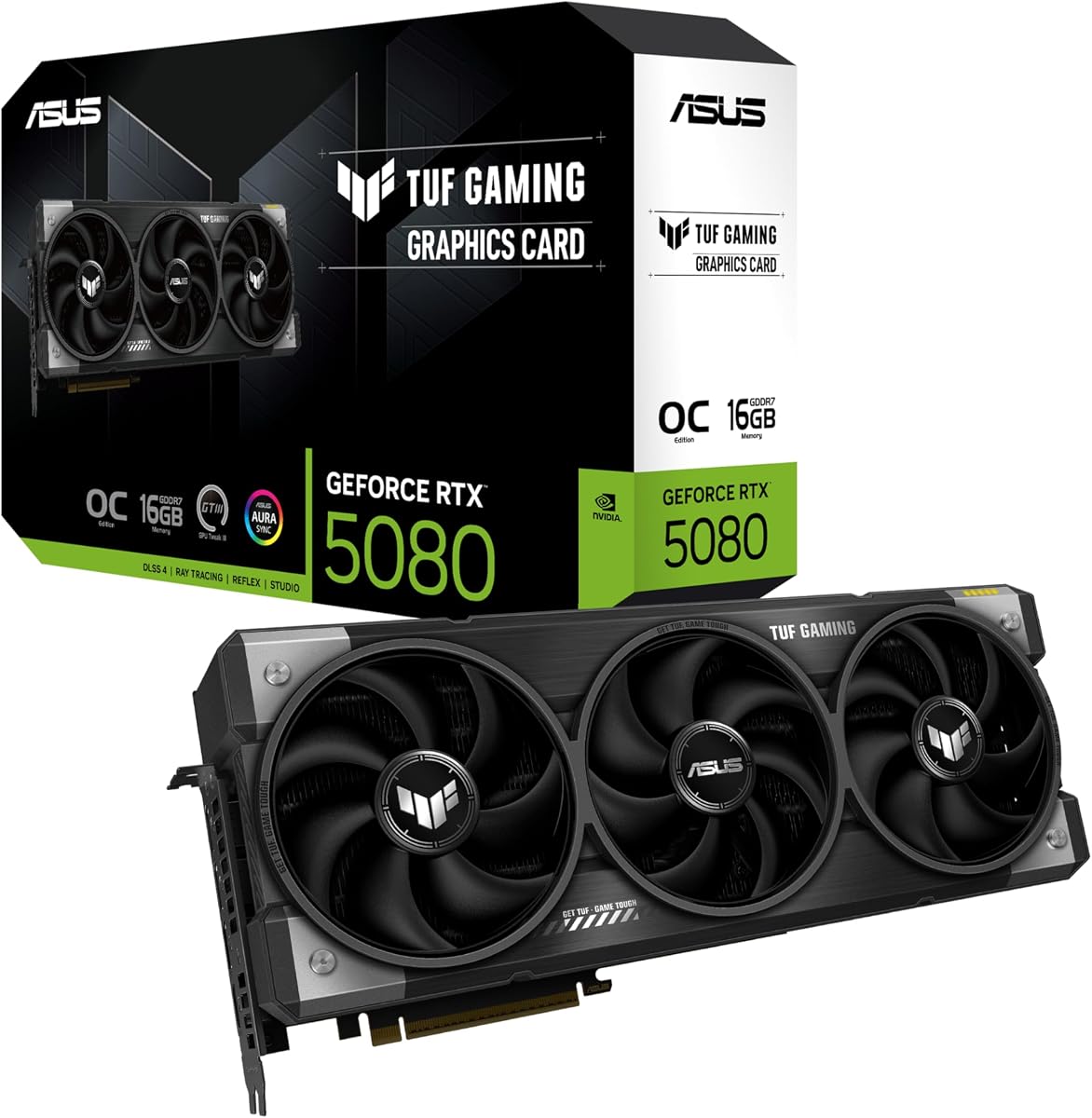
The ASUS TUF RTX 5080 combines power with durability. It rates 4.6 and is built for long-term reliability.
We may earn a commission when you buy through this link, at no additional cost to you.
Military-grade components and phase-change pads ensure thermal stability. Auto-Extreme manufacturing improves overall build quality.
Its large size needs a roomy case. Power requirements are high, so check your PSU before buying.
Best for users who prioritize longevity and robust build quality in a high-performance card.
Phase-change thermal pads last longer than paste, keeping temperatures low over years of use.
Military-grade components ensure stable power delivery and extend the GPU's operational lifespan.
We may earn a commission when you buy through this link, at no additional cost to you.
This card offers a compelling alternative with a 4.7 rating. It balances speed and memory effectively for Comfyui tasks.
We may earn a commission when you buy through this link, at no additional cost to you.
16GB GDDR6 and PCIe 5.0 support ensure broad compatibility. WINDFORCE cooling keeps temperatures in check.
Lack of specific AI drivers may limit some tools. Still, raw performance makes it a strong contender.
Choose this if you want a capable card that handles modern workflows without breaking the bank.
Hawk Fans and server-grade gel ensure effective heat dissipation during intense rendering tasks.
PCIe 5.0 support future-proofs your system for upcoming bandwidth demands.
We may earn a commission when you buy through this link, at no additional cost to you.
Rated at 4.7, this card delivers excellent value for entry-level Comfyui builds. It is compact and efficient.
We may earn a commission when you buy through this link, at no additional cost to you.
16GB memory is sufficient for many models. Dual BIOS allows easy tuning between performance and quiet modes.
It may lack some specialized AI optimizations. However, the performance and price balance out well.
A top pick for budget users who need solid performance without excessive power or space requirements.
2.5-slot design maximizes compatibility, fitting into smaller cases without sacrificing cooling efficiency.
0dB technology ensures fans stop under light loads, keeping the system quiet when idle.
We may earn a commission when you buy through this link, at no additional cost to you.
This GPU earns a 4.7 rating for its balanced features and reliability. It suits medium-scale Comfyui workflows well.
We may earn a commission when you buy through this link, at no additional cost to you.
Blackwell architecture with 12GB GDDR7 delivers solid performance. Thermal pads ensure stability over time.
Memory size might limit very large models. The cost is higher than lower-tier cards but justified by performance.
Buy this if you need dependable performance and good thermal management without top-tier expense.
Phase-change pads outlast traditional paste, ensuring lower temps under sustained workloads.
GPU Tweak III software allows intuitive controls for clock speeds and fan curves.
We may earn a commission when you buy through this link, at no additional cost to you.
Rated 4.3, this card is ideal for basic Comfyui nodes. It offers modern architecture in a compact form.
We may earn a commission when you buy through this link, at no additional cost to you.
8GB GDDR6 is enough for smaller tasks. The 2-slot design fits almost any system easily.
Memory limits may prevent complex workflows. Still, it delivers solid value for entry-level users.
Best for small systems needing just enough power for AI tasks without bulky hardware.
2-slot design maximizes compatibility for small chassis and limited clearance setups.
Low power draw ensures minimal heat output and energy consumption during regular use.
We may earn a commission when you buy through this link, at no additional cost to you.
This card gets a 4.4 rating for reliable AI performance in a compact frame. It uses modern Tensor Cores.
We may earn a commission when you buy through this link, at no additional cost to you.
Blackwell architecture enables efficient generation. Dual-fan cooling keeps it stable during regular use.
It may struggle with huge models due to memory limits. But for most users, it is a strong daily driver.
Good for users wanting balanced performance and size without compromising on modern features.
5th-Gen Tensor Cores enable faster AI processing and lower power usage during tasks.
VelocityX software offers easy controls for tuning performance and monitoring system temps.
We may earn a commission when you buy through this link, at no additional cost to you.
Selecting the right GPU depends on your specific workflow needs and budget constraints.
Memory determines how large models you can run without swapping. 16GB is generally safe for most users while 24GB+ handles enterprise work.
Choose the highest memory possible within budget to future-proof your setup against growing model sizes.
Modern architectures offer better efficiency and AI accelerators. Look for Blackwell or similar modern chipsets for best results.
Ensure the architecture supports necessary tensor cores for your specific Comfyui workflow requirements.
Sustained loads generate heat. Good cooling prevents throttling. Blower fans fit small cases while dual fans run cooler.
Pick a cooling solution that matches your case size and ambient room temperature to maintain stability.
PCIe Gen 5 offers faster data transfer between CPU and GPU. This reduces bottlenecks during complex node chains.
Ensure your motherboard supports the PCIe version for best performance potential in your specific build.
High-performance GPUs need significant power. Check TDP and ensure your PSU has enough headroom to avoid instability.
Calculate total system power draw to select a suitable power supply before buying any high-end card.
Drivers impact stability. NVIDIA cards often have wider AI support. AMD and Intel options vary by software tool.
Verify that your software stack supports the GPU brand and driver before committing to a purchase.
GPUs vary from compact 2-slot designs to long triple-fan models. Measure your case before buying to ensure fit.
Match the GPU length and slot width to your system chassis to avoid compatibility issues later.
Higher price does not always mean better fit. Balance cost against memory and speed needs for your specific workflow.
Evaluate if a higher tier card justifies its extra cost for your daily usage patterns and future plans.
Install the latest drivers from the manufacturer website. Ensure Comfyui and your dependencies are up to date for best compatibility.
Monitor temperatures using tools like GPU Tweak III to keep cooling efficient. Clean dust regularly to maintain airflow and prevent throttling.
Avoid running GPUs at maximum clock continuously for years without breaks. Use power profiles to balance performance and thermal health.
At least 12GB is recommended for most workflows. Larger models benefit from 16GB or more. Less than 12GB may limit node complexity and model size.
AMD GPUs can work but require specific support and drivers. NVIDIA is typically more straightforward for AI workflows due to native optimizations.
It helps data transfer speeds but PCIe 4.0 is often enough. Gen 5 ensures future compatibility for higher bandwidth requirements.
Yes, good cooling prevents thermal throttling. Sustained tasks need stable temperatures. Better fans or liquid cooling help maintain performance.
Desktop GPUs are preferred due to better cooling and power. Laptop GPUs often lack VRAM or cooling for sustained workloads.
ECC memory is useful for enterprise reliability. Most casual users do not strictly need ECC unless running critical long tasks.
High-end GPUs may need 850W+. Check TDP on the card. Total system power should stay below 80 percent PSU capacity.
Update monthly to keep features stable. Avoid outdated drivers that may break Comfyui or cause crashes. Keep backups of settings.
We highlighted ten options ranging from entry to enterprise. The top picks cover various needs for budget and performance.
Prioritize memory capacity and architecture stability to ensure smooth workflows. Always match your PSU and case space.
Verify current prices and stock before buying since market values shift rapidly. Check all specs for your build setup.