
APC ES620 Dual GPU AI Workstation
4.0Editor score
Dual RTX 5090 GPUs
256GB DDR5 RAM
360mm liquid cooling
This guide compares the top dual GPU AI setups for local large language model inference, fine-tuning, and generative AI workloads in October 2026.
Finding the right dual GPU AI setup is critical for developers and researchers running large language models locally. These systems combine massive VRAM and compute power to handle complex inference and training tasks efficiently.
We evaluated ten leading configurations based on architecture, memory bandwidth, cooling solutions, and software compatibility. Each entry offers a unique balance of performance, expandability, and cost for different AI workflows.
Every review highlights specific strengths and trade-offs to help you match hardware to your needs. Note that availability and pricing fluctuate frequently, so check current listings before purchasing.
4.0Editor score

4.5Editor score

4.5Editor score
The following table breaks down key specifications across all ten systems to help you compare memory, compute, and form factors at a glance.


This dual-GPU workstation card stands out for its 48GB VRAM pool designed to run quantized models locally without cloud dependency. Its combined 394 TOPS compute makes it a strong candidate for developers needing high-throughput inference on a single card.
We may earn a commission when you buy through this link, at no additional cost to you.
The design integrates two Arc Pro B60 cores with 48GB GDDR6 memory across a 192-bit bus. This allows full model loading for 70B-class quantized setups like DeepSeek-R1. The PCIe 5.0 x8 dual interface ensures sufficient bandwidth when paired with bifurcating motherboards.
While newer than established NVIDIA solutions, software support for PyTorch and vLLM is native and improving. The main trade-off is motherboard compatibility for lane splitting, which some consumer boards may lack.
Buy this if you need a compact, cost-effective solution for running large local models with minimal infrastructure overhead.
The 48GB memory pool eliminates splitting complexity, allowing full models to load into a single address space for faster inference.
Each GPU operates independently, enabling separate task assignment for complex dialogues and parallel workloads.
We may earn a commission when you buy through this link, at no additional cost to you.
APC builds this workstation around dual RTX PRO 6000 GPUs delivering 192GB of professional VRAM. It suits teams needing high-fidelity rendering alongside large model inference without splitting GPU tasks across separate cards.
We may earn a commission when you buy through this link, at no additional cost to you.
The Ryzen 9-9950X CPU provides robust single-core speed for preprocessing while GPUs handle compute-heavy inference. With 256GB system RAM and 8TB NVMe storage, data bottlenecks are minimized.
The liquid cooling system maintains stable temperatures under continuous loads. However, the 1600W PSU draws significant power which might increase operational costs.
Choose this if you need maximum NVIDIA VRAM in a dual-GPU form factor with enterprise support and warranty.
Each RTX PRO 6000 carries 96GB, enabling ultra-large context windows and complex multi-modal workloads.
Drivers and OS are preloaded to reduce setup time for immediate workflow deployment.
We may earn a commission when you buy through this link, at no additional cost to you.
This workstation leverages dual RTX 5090 GPUs with 64GB GDDR7 memory each to deliver exceptional raw performance. It targets users who prefer consumer GeForce cards for cost-effective training and inference.
We may earn a commission when you buy through this link, at no additional cost to you.
The Ryzen 9-9950X processor boosts up to 5.7GHz, supporting data loading and preprocessing during training. 256GB DDR5 RAM ensures the system never stalls during large dataset handling.
Liquid cooling keeps the CPU stable, but the GPUs need adequate case airflow. Ensure your power infrastructure supports 1600W draw.
Pick this if you want maximum consumer GPU performance for local training and have the physical space for dual cards.
Next-gen memory enables faster data throughput during fine-tuning and inference on large models.
High clock CPU paired with dual GPUs prevents CPU bottlenecks in compute-heavy workflows.
We may earn a commission when you buy through this link, at no additional cost to you.
The DGX Spark brings NVIDIA's full AI software stack to a personal desktop. It supports local fine-tuning and inference with up to 128GB unified memory per unit.
We may earn a commission when you buy through this link, at no additional cost to you.
Its Grace Blackwell architecture delivers up to 1 petaFLOP of performance. This system is designed for rapid iteration without cloud latency.
The 2-pack bundle offers even more power for clustered testing. Note that memory is fixed to 128GB per unit limiting future scalability.
Choose this if you need reliable enterprise-level AI performance in a compact, energy-efficient desktop form.
Unified architecture allows CPU and GPU to share high-bandwidth memory pool reducing data transfer latency.
Seamless integration accelerates development cycles and deployment readiness.
We may earn a commission when you buy through this link, at no additional cost to you.
This 4U rackmount server packs eight RTX PRO 6000 GPUs delivering 768GB of VRAM. It targets enterprise clusters needing massive inference capacity locally.
We may earn a commission when you buy through this link, at no additional cost to you.
Dual EPYC 9965 CPUs with 24-channel DDR5 support extreme data throughput. The system includes 8 hot-swap U.2 NVMe slots and 15 total NICs for advanced networking.
Power requirements are substantial at 3200W with redundant PSUs. It demands a server room environment rather than a home office.
Select this if you require enterprise-grade density and VRAM capacity for multi-user deployments.
Eight GPUs in 4U form factor maximizes compute per rack unit.
Multiple NICs allow direct CPU-to-network connectivity reducing latency for cluster tasks.
We may earn a commission when you buy through this link, at no additional cost to you.
While single GPU, this workstation offers 32 cores and ECC RAM for stable data processing. It supports RTX 5090 for AI workloads needing 32GB VRAM.
We may earn a commission when you buy through this link, at no additional cost to you.
The Threadripper 9970X handles parallel data ingestion efficiently. Networking includes 10GbE for fast file transfers.
It suits workflows needing CPU parallelism more than raw GPU count. If you require dual GPUs, this might be limiting.
Buy this if you need high core count for preprocessing combined with strong GPU inference.
Error-correcting RAM prevents data corruption during long inference sessions.
10GbE LAN accelerates transfer of large datasets and models.
We may earn a commission when you buy through this link, at no additional cost to you.
This system houses three RTX PRO 6000 GPUs with 288GB VRAM and a 192-core EPYC processor. It targets heavy local training and CAD workflows needing extreme thread counts.
We may earn a commission when you buy through this link, at no additional cost to you.
With 768GB system RAM and Gen5 SSDs, data pipelines are maximized. The 2800W PSU ensures stability under full load.
It requires significant physical space and power. Not ideal for standard home setups but excellent for dedicated labs.
Choose this if you need maximum multi-GPU capability in a single chassis.
192 cores handle data preprocessing while GPUs focus on training.
OS and drivers preloaded for immediate workflow access.
We may earn a commission when you buy through this link, at no additional cost to you.
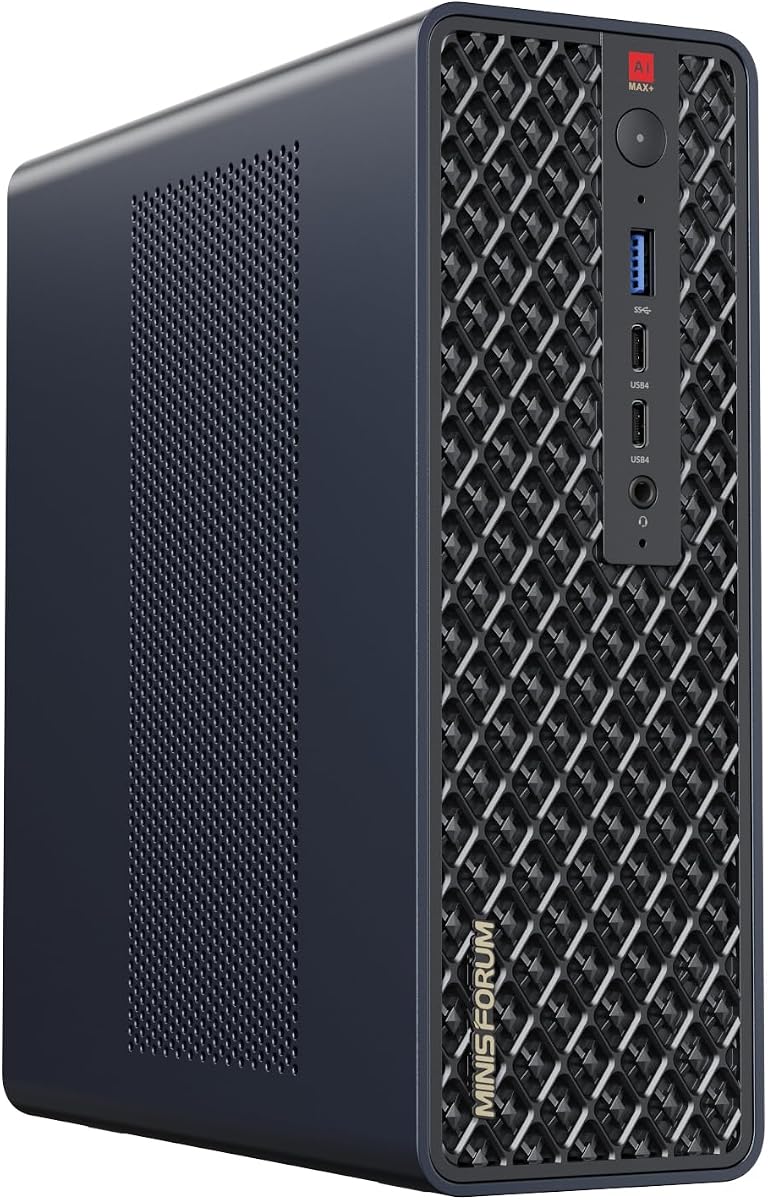
This Mini PC integrates Ryzen AI Max+ 395 with 128GB shared memory. It supports local LLM inference and multimodal tasks efficiently.
We may earn a commission when you buy through this link, at no additional cost to you.
Two units can cluster to run larger models. It fits easily on desks or racks.
Memory is unified on the SoC meaning it can't be upgraded later. Ensure your needs fit the 128GB limit.
Select this for space-constrained setups needing cluster flexibility and integrated AI NPU.
Multiple units can be cascaded to run 235B parameter models locally.
USB4 V2 80Gbps ensures fast external storage and display connections.
We may earn a commission when you buy through this link, at no additional cost to you.
This Max-Q GPU packs 96GB GDDR7 into a 300W card. It suits professional workstations needing high memory without massive power draw.
We may earn a commission when you buy through this link, at no additional cost to you.
Ideal for rendering and AI inference simultaneously. The 3-year warranty ensures long-term use.
Single GPU means limited VRAM compared to multi-card setups. Check power supply compatibility.
Choose this for reliable single-card performance in constrained power environments.
Max-Q reduces power consumption while maintaining high memory bandwidth.
Four DisplayPort 2.1 outputs support complex visualization workflows.
We may earn a commission when you buy through this link, at no additional cost to you.
This Mini PC features AMD Ryzen AI Max+ with 16 cores and 50 TOPS NPU. It handles AI workflows in a small form factor.
We may earn a commission when you buy through this link, at no additional cost to you.
Five video outputs allow multi-monitor setups. Dual 10G LAN ports ensure fast data transfers.
Integrated GPU memory limits heavy training but is sufficient for inference. PCIe slot allows expansion if needed.
Select this for desktop space savings and versatile connectivity.
HDMI and four USB4 video outputs support up to five monitors.
Built-in PCIe x16 slot allows adding external storage or capture cards.
We may earn a commission when you buy through this link, at no additional cost to you.
Selecting the right dual GPU setup depends on your model size, training needs, and physical space.
VRAM determines the largest model you can load. For LLMs above 70B parameters, aim for 48GB or more total to avoid offloading to system RAM.
Prioritize total VRAM over core count for local inference.
High bandwidth speeds up data transfer during inference. Look for GDDR6 or GDDR7 and wide bus interfaces like 512-bit or dual PCIe 5.0.
Higher bandwidth reduces latency during token generation.
Ensure your motherboard supports PCIe bifurcation if using dual GPUs on consumer boards. PCIe 5.0 x8 dual lane helps maintain full performance.
Check motherboard manuals for lane splitting support before purchasing.
Dual GPUs often require 1000W+ PSUs. Verify your power supply wattage and connectors match the hardware.
Use high-efficiency 80 PLUS Gold or Titanium units for stability.
Sustained inference generates heat. Liquid cooling or robust airflow setups are essential for long sessions.
Prioritize systems with dedicated fans or liquid cooling for continuous use.
Check support for PyTorch vLLM and specific frameworks. NVIDIA generally has wider ecosystem support than other vendors.
Ensure the hardware supports your chosen inference server.
Measure your desk or rack space. Dual GPU setups require full tower cases or rackmount enclosures.
Verify case dimensions and ventilation before finalizing purchase.
Install latest GPU drivers and ensure PCIe bifurcation is enabled in BIOS. This guarantees both GPUs are recognized fully.
Set up virtual environments for different model versions. Tools like Docker or vLLM simplify deployment.
Monitor thermal throttling using management software. Keep GPU temperatures below safe limits to prolong hardware life.
For 70B quantized models, you need at least 48GB of unified VRAM. Less will force model offloading to system RAM significantly slowing performance.
Yes, software like vLLM allows splitting requests across GPUs. This improves throughput for multi-user or batch tasks.
For dual PCIe GPUs in consumer boards, bifurcation ensures full bandwidth. Check motherboard specs before purchasing dual GPU cards.
Expect 1000W to 1600W total draw including CPU and storage. Ensure your PSU and electrical circuit support this load.
It helps for continuous inference but high-airflow systems work too. Prioritize stable temperatures to avoid thermal throttling.
Yes, compact units like the MS-S1 MAX support clustering. This balances cost and scalability better than single large systems.
We highlighted top picks ranging from compact cluster nodes to enterprise servers. The WEELIAO MAXSUN card offers strong performance per watt.
Prioritize VRAM capacity and bandwidth for local LLM success. Ensure motherboard and power compatibility before purchasing.
Check current availability and warranty terms as listings update frequently. Choose the system that fits your space and workload needs.