
HiLetgo ENC28J60 Ethernet LAN Network Module
4.3Editor score
Low cost ENC28J60 chip
3.3V power supply
HR911105A RJ45 connector
This guide compares the top Arduino Lan Ethernet Modules for reliable networking, SPI interfaces, and TCP/IP support in IoT and microcontroller projects.
Selecting the right Arduino Lan Ethernet Module is essential for any project requiring stable wired internet connectivity. These modules allow microcontrollers to communicate over local networks or the web using standard protocols.
We evaluated ten leading options based on chipset performance, voltage compatibility, and ease of integration. Our analysis focuses on real-world reliability, documentation quality, and community support for developers.
Each pick highlights key strengths and limitations to help you match hardware to your needs. Prices and availability fluctuate frequently so verify current listings before ordering components for your build.
4.3Editor score

4.2Editor score

4.7Editor score
The following table presents a side-by-side comparison of all ten evaluated modules. It highlights core specifications and connectivity options to simplify your selection process for specific application requirements.


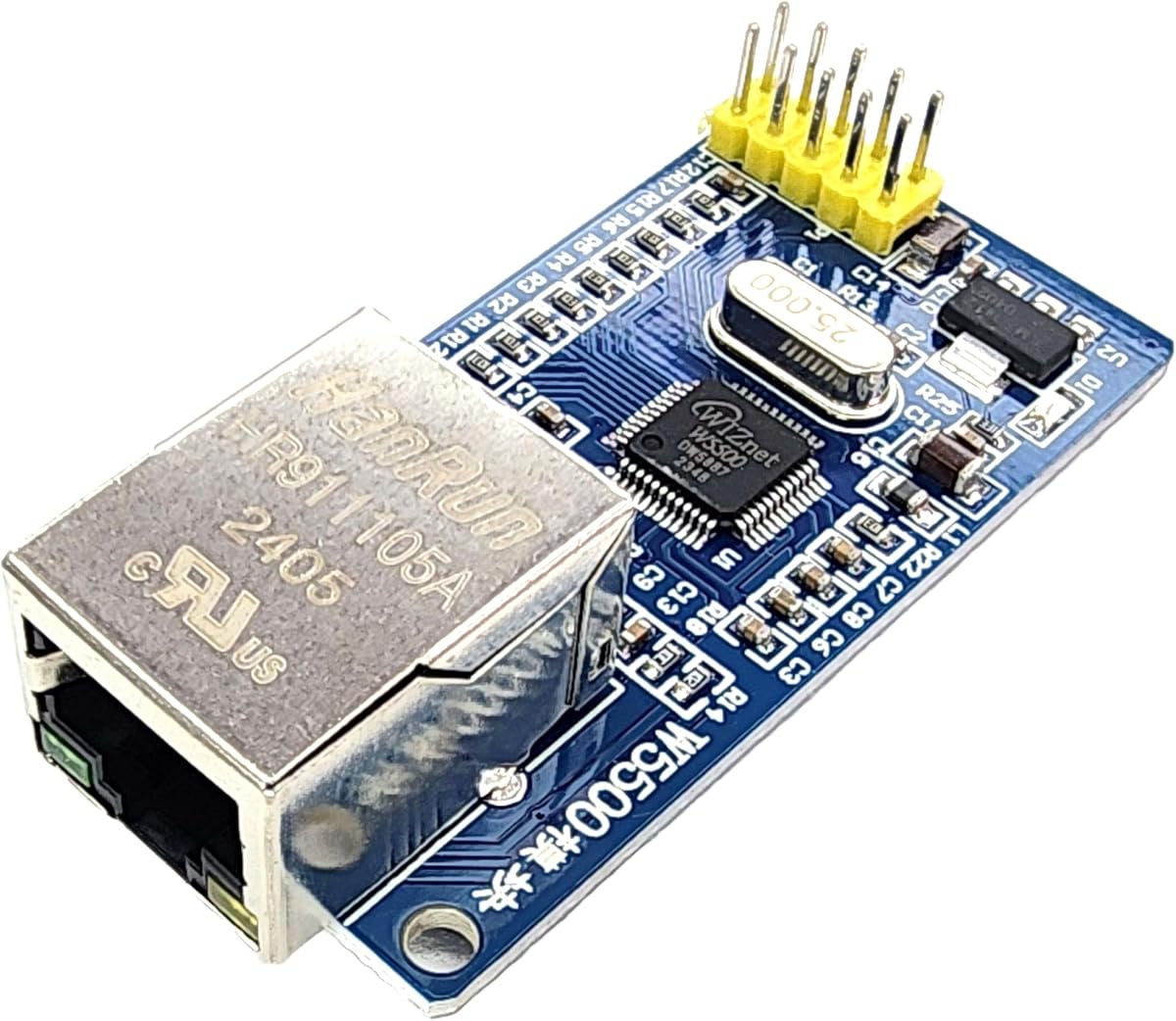

This module stands out as a top contender for robust Arduino Lan Ethernet Module connectivity. It features the W5500 chip which offers reliable hardware TCP IP processing. Users appreciate the high ratings for stability and speed in network tasks.
We may earn a commission when you buy through this link, at no additional cost to you.
The core strength lies in its internal memory and socket management. With 32K bytes for TX RX buffers and support for eight independent sockets simultaneously you can manage complex connections without overloading the microcontroller. This makes it ideal for multitasking IoT applications.
While the hardware is excellent some users note that power supply needs attention. The module operates at 3.3V or 5V so ensuring stable current prevents communication errors. Also the physical pin spacing might require level shifters for certain boards.
If you need a dependable connection for industrial or advanced projects this kit is highly recommended. It balances performance and versatility effectively. The inclusion of two units offers value for prototyping and testing multiple setups simultaneously.
The dedicated hardware stack reduces processor load significantly allowing your microcontroller to focus on application logic rather than network packet handling and routing tasks.
Supporting eight simultaneous sockets means you can host multiple server connections or client requests at once without needing complex software threading or context switching mechanisms.
We may earn a commission when you buy through this link, at no additional cost to you.
This Ethernet module focuses on speed and simplicity for developers working with STM32 or Arduino boards. It leverages the W5500 chip for efficient TCP IP management. The design is optimized for high speed serial communication.
We may earn a commission when you buy through this link, at no additional cost to you.
Performance is driven by the SPI interface which allows rapid data exchange between the host processor and the network chip. The TTL level control simplifies wiring since it matches common logic levels. This reduces the need for extra interface circuits in your circuit.
Power management is a key consideration here. The module requires a stable 3.3V external supply of at least 200mA. Without proper regulation voltage drops can cause connection resets. This is a critical factor for battery powered or low power systems.
Ideal for projects needing quick network response times this module is a solid choice. It fits well in compact enclosures due to its small footprint. Ensure you have adequate power and your project will benefit from its reliable throughput.
The 3.3V SPI interface matches standard logic levels allowing direct connection to many modern microcontrollers without requiring additional level shifting components or complex wiring adjustments.
Stable external power is crucial for consistent performance so plan your power architecture carefully to meet the minimum current draw and ensure continuous operation during data transmission.
We may earn a commission when you buy through this link, at no additional cost to you.
This listing offers a five pack of W5500 Ethernet modules making it a practical choice for teams or larger production runs. Each module features the reliable W5500 chip for robust network connectivity. The consistent PCB size helps with standardization.
We may earn a commission when you buy through this link, at no additional cost to you.
The 23 by 25mm form factor ensures that fit into most project boxes or breadboards easily. Users value the consistent performance across all units in the pack. The TTL level interface and 3.3V supply make integration straightforward with common development boards.
Attention to power supply stability is still necessary to avoid intermittent errors. The module demands a continuous 3.3V supply with sufficient current. Fluctuations can disrupt network handshakes so use a dedicated regulator if the main supply is noisy.
For educational kits or multi-device deployments this pack provides excellent convenience. Having five units means you can build several prototypes simultaneously without waiting for shipping. It simplifies logistics for classroom environments or small scale manufacturing.
Acquiring five modules at once reduces per unit costs and ensures part consistency across your entire deployment which is vital for mass production or classroom experiments.
The uniform physical dimensions allow for easier design reuse and mounting across different projects without needing custom enclosures or layout adjustments for each new build.
We may earn a commission when you buy through this link, at no additional cost to you.
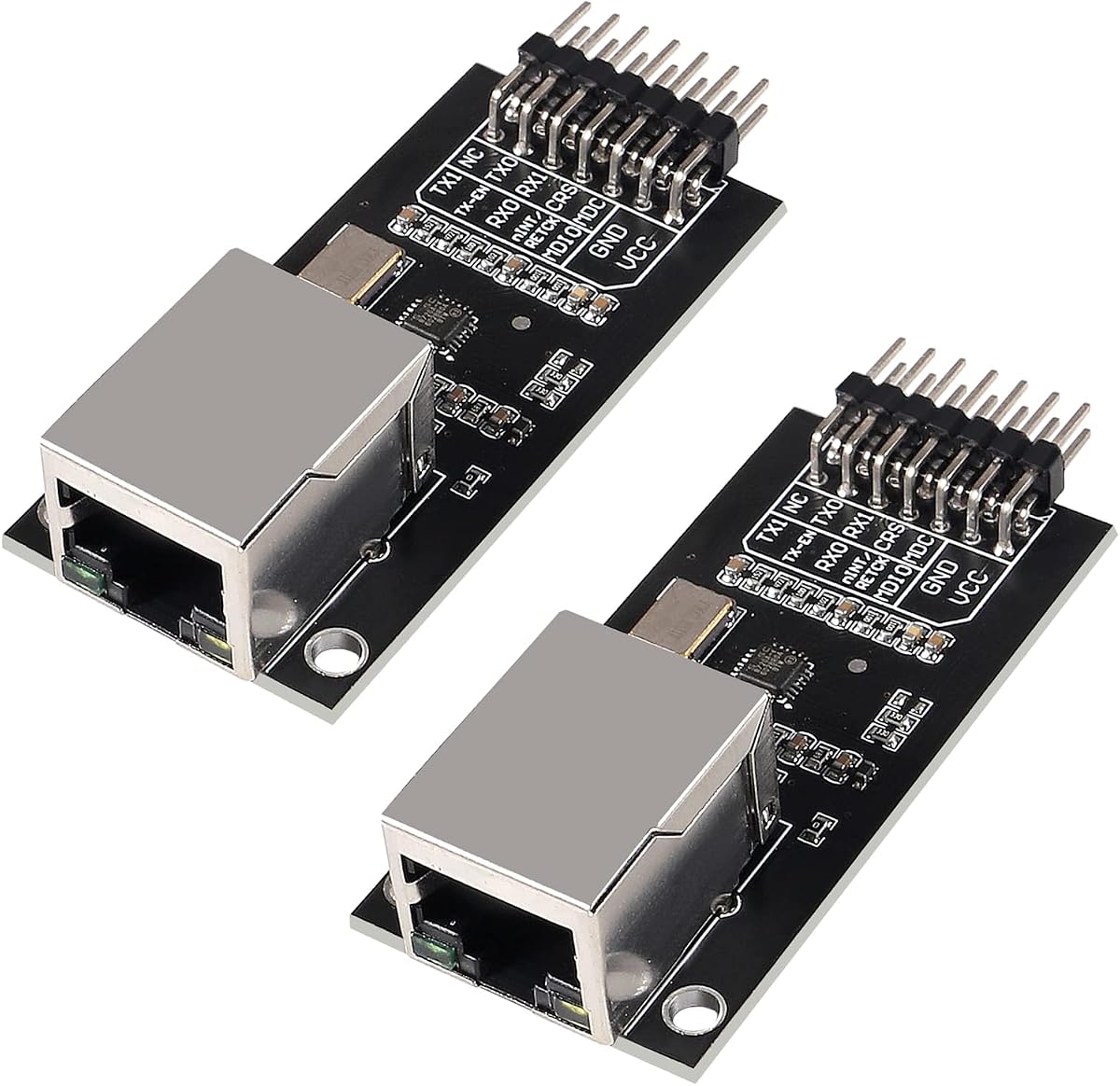
This dual pack includes modules with industrial grade features like auto-negotiation and support for both full and half duplex modes. The hardware TCP IP stack offloads network tasks from the microcontroller efficiently. It is designed for robust operation.
We may earn a commission when you buy through this link, at no additional cost to you.
The 10/100Mbps PHY ensures compatibility with various network speeds. It manages eight sockets simultaneously and supports Wake on LAN via UDP protocols. These features make it suitable for scenarios where device management and connectivity status tracking are critical.
However the current rating indicates potential reliability or consistency concerns that buyers should investigate. While specifications look strong real world feedback suggests possible QC variance or configuration challenges. Always test before deploying to critical systems.
For those needing advanced PHY features in a compact module this option is worth considering if recent batches perform well. Ensure you match the power requirements exactly. The feature set supports complex network tasks effectively when units are functional.
Embedded auto-negotiation allows the module to automatically match speed and duplex settings with the connected router reducing manual configuration errors and improving plug and play usability.
The ability to wake up devices remotely via UDP packets simplifies power management strategies and enables efficient system control without constant active polling of the microcontroller.
We may earn a commission when you buy through this link, at no additional cost to you.
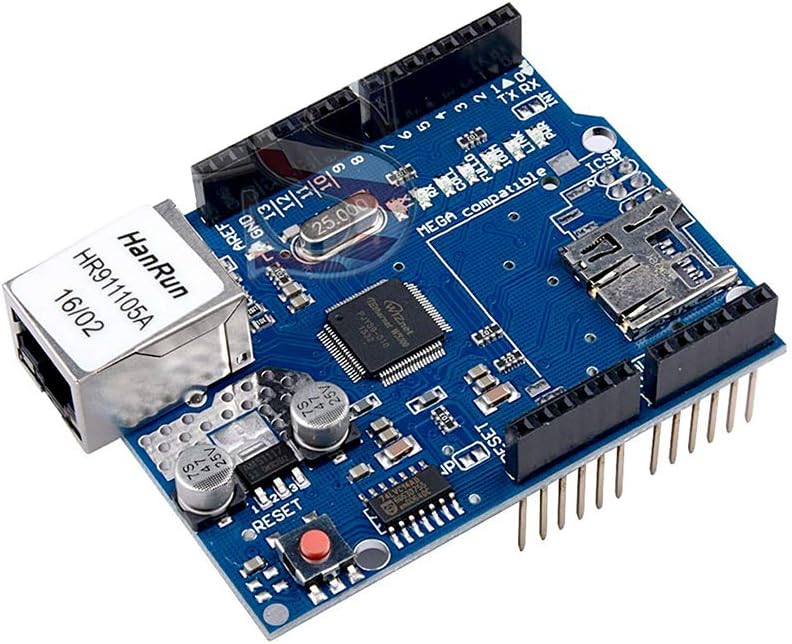
This shield is designed to stack directly on Arduino boards like the UNO and MEGA providing an immediate network connection. The integrated SD card slot allows for data logging and file hosting capabilities alongside network functions. It is user friendly.
We may earn a commission when you buy through this link, at no additional cost to you.
Using the W5100 chip it provides both TCP and UDP support. The standard RJ45 jack connects easily to routers or switches. This setup eliminates the need for separate wires and soldering which simplifies initial prototyping and testing phases significantly.
The shield form factor can block access to headers on smaller boards. It is also based on older technology compared to SPI based modules which might limit speed or integration flexibility. But for simple setups it remains a convenient choice.
If you prefer a stackable solution that requires minimal wiring this shield is a strong candidate. It works well for teaching environments or simple web server projects. Just ensure your board can accommodate the height without physical interference.
The on board SD slot enables local data storage and file serving which is extremely useful for logging sensor data or hosting web content directly from the microcontroller board.
Direct stacking onto the Arduino board reduces wiring complexity and ensures a secure mechanical connection making it easier for beginners to assemble a complete networked system.
We may earn a commission when you buy through this link, at no additional cost to you.
This module uses the ENC28J60 controller which is a classic choice for basic networking needs. It is highly affordable and works with a wide range of microcontrollers including AVR and PIC. The design is compact and easy to integrate into tight spaces.
We may earn a commission when you buy through this link, at no additional cost to you.
The board includes a 25MHz crystal oscillator for stable timing during SPI communication. The HR911105A isolation transformer ensures reliable signal quality over Ethernet cables. It operates at 3.3V which is compatible with many logic levels without extra components.
Speed and buffer capacity are lower compared to newer W5500 options. This might limit throughput for high data rate applications. However for simple commands or status checks it performs well enough. The cost benefit is a major driver for selection.
Ideal for budget projects or learning how networking works this module is excellent. It provides the basics without complexity. If you need to connect a sensor to a network occasionally this is a perfect cost effective solution.
The low component count and simpler controller architecture result in a very low price point making it accessible for students and hobbyists exploring network connectivity for the first time.
Compatibility with AVR and PIC as well as STM32 means you can use the same hardware design across different projects without redesigning your microcontroller interface code.
We may earn a commission when you buy through this link, at no additional cost to you.
This bundle offers five reliable ENC28J60 modules which are IEEE 802.3 compliant ensuring standard Ethernet compatibility. The high user rating suggests good build quality and consistent performance across the pack. It is a great resource for bulk deployments.
We may earn a commission when you buy through this link, at no additional cost to you.
Each unit features a dedicated 25MHz crystal and robust isolation transformer to maintain signal integrity over distance. This hardware quality helps prevent communication errors even in noisy environments. The 3.3V operation makes it safe for most microcontrollers.
While it does not match the speed of more advanced chips the reliability is key for static tasks. The five pack allows you to distribute connectivity across multiple nodes easily. This reduces the need to order separately over time.
For projects like sensor networks where many devices connect to a central hub this set is highly useful. The components are tested and verified for quality. It balances affordability with a level of industrial standard adherence.
Meeting IEEE 802.3 standards ensures interoperability with standard network switches and routers avoiding proprietary quirks that might cause connection issues in mixed hardware environments.
The HR911105A isolation transformer protects the microcontroller from electrical surges on the network line and ensures signal quality remains high even with longer cable runs.
We may earn a commission when you buy through this link, at no additional cost to you.
This module is specifically noted for its compatibility with ESP32 and ESP8266 boards which often have specific voltage needs. It features a full size RJ45 port for easy physical connection. Users rate it highly for ease of use and performance.
We may earn a commission when you buy through this link, at no additional cost to you.
The SPI interface allows fast communication with the microcontroller. It supports standard UDP and TCP protocols for diverse internet tasks. The module is designed to be straightforward for educational and smart projects alike.
The high rating indicates a lack of common defects or confusion. Online tutorials and sample code simplify the development process significantly. This makes it ideal for beginners who need clear guidance to get started quickly.
If you are building a smart home device or IoT sensor this is a top choice. The combination of compatibility and support resources ensures a smooth experience. It bridges the gap between hobbyist needs and professional standards effectively.
Designed to work well with 5V and 3.3V logic levels it integrates cleanly with popular Wi Fi enabled boards ensuring you can add wired stability without complex voltage conversion steps.
The availability of detailed tutorials and sample code online helps reduce the learning curve for developers new to Ethernet protocols and hardware integration.
We may earn a commission when you buy through this link, at no additional cost to you.
This board uses the LAN8720 transceiver which is known for low power consumption and flexible power management. It supports HP Auto-MDIX which simplifies cabling by detecting cable types automatically. It is great for embedded web servers.
We may earn a commission when you buy through this link, at no additional cost to you.
The module includes an integrated 1.2V regulator and allows IO voltages from 1.6V to 3.6V. This flexibility supports a wide range of microcontrollers. The ultra low power design makes it suitable for battery or energy sensitive applications.
Setup can be more involved than standard SPI modules due to specific register configurations. The physical layer details require attention to ensure stable operation. However the power savings are a significant advantage for long term deployments.
For specialized embedded projects needing efficient power usage this module is a strong candidate. Ensure you have the documentation to handle the PHY settings. It offers a high performance alternative to common SPI based solutions.
HP Auto-MDIX support allows the module to automatically adapt to straight through or crossover cables reducing the need for specific cable types in different network setups.
The optimized power architecture allows the module to run efficiently even on single 3.3V supplies making it ideal for energy constrained or battery operated network nodes.
We may earn a commission when you buy through this link, at no additional cost to you.
This module from Hailege features the ENC28J60 chip which is well supported for legacy controllers like 51 AVR and LPC. It includes a 25MHZ crystal and HR911105A RJ45 connector for stable network signals. It is a dependable component.
We may earn a commission when you buy through this link, at no additional cost to you.
The DIP28 package style ensures mechanical robustness and standard pin layout. The 3.3V power supply requirement matches most modern logic levels. Users appreciate the straightforward integration and stable connection performance in various projects.
While it lacks the advanced features of newer W5500 options it fulfills the basic needs for connecting microcontrollers to networks. The high rating reflects consistent quality. It is a safe choice for general connectivity tasks.
If you are working with older controllers or need a simple interface this module is recommended. It provides a solid bridge between hardware and network protocols. Ensure your power supply is stable to maximize its performance and longevity.
Broad support for older architectures like 51 and AVR ensures that even legacy systems can be upgraded with network capabilities without requiring a full hardware redesign.
The use of standard RJ45 connectors and typical SPI pins simplifies physical wiring and allows reuse of existing Ethernet cables and network infrastructure seamlessly.
We may earn a commission when you buy through this link, at no additional cost to you.
Choosing the right module involves evaluating chipset capabilities voltage requirements and physical form factors. Consider how each factor impacts your project's complexity and performance needs.
The core chip determines data throughput and protocol handling. W5500 chips offer advanced features like 8 sockets and higher speeds suitable for complex tasks. ENC28J60 chips are slower but sufficient for basic commands.
Select a chipset that matches your data volume and multitasking requirements to avoid bottlenecks.
Modules operate at different voltage levels like 3.3V or 5V. Ensure your microcontroller logic levels match the module's requirements to prevent communication failures. Check if level shifters are needed for your specific board.
Always verify voltage specs before wiring to protect both the microcontroller and the network module.
SPI connections vary in speed and pin configuration. Some modules support faster clock rates for quick data transfers. Others use simpler wiring setups suitable for beginners. Check the SPI mode supported.
Choose an SPI interface that matches your processor's capabilities for optimal performance.
Modules come as shields that stack or compact breakout boards. Shields are easier to connect but taller. Breakouts fit smaller enclosures. Consider your project's physical space constraints.
Ensure the size fits your enclosure and does not block essential pins on your board.
Network modules draw significant current especially during data transmission. Some need external regulators while others share power. Insufficient power causes drops. Always review current draw specs.
Provide a stable power source to ensure reliable network connectivity at all times.
Quality documentation and community support help you troubleshoot effectively. Some manufacturers provide libraries and examples. Others rely on generic guides. Good docs save development time.
Prioritize modules with active communities and clear code samples for your development board.
Build quality affects long term performance. Transformers and crystals stabilize connections. Check user reviews for failure rates. Industrial grade components last longer in harsh environments.
Invest in modules with proven reliability for critical applications where downtime is unacceptable.
Buying in packs can save money for multiple projects. However single units allow you to test first. Balance cost against the risk of faulty units in a batch.
Start with one unit to test compatibility before committing to a bulk purchase.
Connect the module to your microcontroller using the correct SPI pins. Ensure that power supply is stable and meets the current requirements before powering up the system.
Upload example code to initialize the network library. Configure the IP address or use DHCP if your network supports it. Test connectivity by pinging a known address from your computer.
Store modules in static-free packaging when not in use. Handle the board gently to avoid damaging the pins or the transformer. Keep the connector clean from dust and debris for reliable plugs.
Yes most modules support 3.3V logic or have tolerant pins. Check the specific datasheet to confirm compatibility. Using a level shifter is safe if there is any uncertainty about voltage levels.
Common causes include incorrect wiring unstable power or wrong IP settings. Verify your RJ45 cable is connected properly to a switch. Check the module's LED status for link indicators.
TCP provides reliable ordered data delivery while UDP is faster but less reliable. Choose TCP for web servers or file transfers. Use UDP for streaming or simple status updates where speed matters more.
For local peer to-peer communication a switch is enough. For internet access you need a router. The module works on both local and internet networks depending on your configuration.
Most modules do not require firmware updates. The chip operates with factory settings. If a specific brand offers updates use their provided tools and follow the manufacturer instructions strictly.
Yes by using different chip select pins on the SPI bus. Ensure the microcontroller has enough digital pins for this setup. Configure unique IP addresses to avoid conflicts on the network.
The top picks for this category highlight reliability across different needs. The HiLetgo W5500 offers strong performance while ENC28J60 options provide budget friendly solutions for various projects.
Prioritize chipset features that match your application such as speed and power efficiency. A module with good documentation will save time during development and troubleshooting phases significantly.
Always check current availability and compatibility before purchasing. Specifications and prices can change so verify details against your latest project requirements for the best outcome.