
SUNLU Filament Dryer S2
4.3Editor score
Large capacity for standard spools
Even drying with built-in spindle
User-friendly touch screen interface
This guide compares the top filament dryers for 3D printing, evaluating features, capacity, and performance to help you choose the right moisture control
Filament dryers are essential tools for anyone serious about 3D printing quality. Moisture in filament causes stringing, poor layer adhesion, and surface defects. A good dryer removes humidity efficiently while maintaining consistent temperatures for various materials like PLA, PETG, and ABS.
We compared ten leading filament dryers based on heating speed, capacity, sealing quality, and ease of use. Our analysis includes models ranging from budget-friendly single spool units to large multi-spool systems designed for high-volume production environments and professional printing workflows.
Each pick highlights specific strengths such as rapid heating, large storage, or precise temperature control. Note that product availability and prices can change frequently. Always verify current specifications and deals before purchasing to ensure you get the best value for your printing needs.
4.3Editor score

4.6Editor score

4.5Editor score
This side-by-side comparison evaluates all ten selected filament dryers across key performance metrics to help you find the ideal match for your specific 3D printing requirements and budget constraints.


This Creality model stands out as the top pick for high-volume users needing efficient moisture control. With a rating of 4.6, it excels in capacity and performance. The dual heating chambers allow you to dry four spools simultaneously, significantly reducing wait times compared to single-unit dryers.
We may earn a commission when you buy through this link, at no additional cost to you.
The standout feature is the dual independent 200W heating chambers which reach up to 85 degrees Celsius. This high temperature capability makes it suitable for advanced filaments like ABS, PC, and ASA that require more heat to drive out embedded moisture effectively. The sealed enclosure ensures spools stay dry between prints.
While the price is higher than basic models, the efficiency gained justifies the cost for serious printers. The only minor drawbacks are the larger physical size and the investment required. However, for users running multiple prints or using hygroscopic materials frequently, these trade-offs are acceptable.
We recommend this dryer for professionals or enthusiasts who print often and need reliable moisture management. It extends filament life and reduces print failures caused by humidity. Investing in this unit pays off through consistent print quality and reduced waste over time.
The dual chambers allow faster drying cycles by heating filament evenly across multiple spools at once.
Reaching 85 degrees enables drying of engineering filaments that standard dryers cannot handle effectively.
We may earn a commission when you buy through this link, at no additional cost to you.
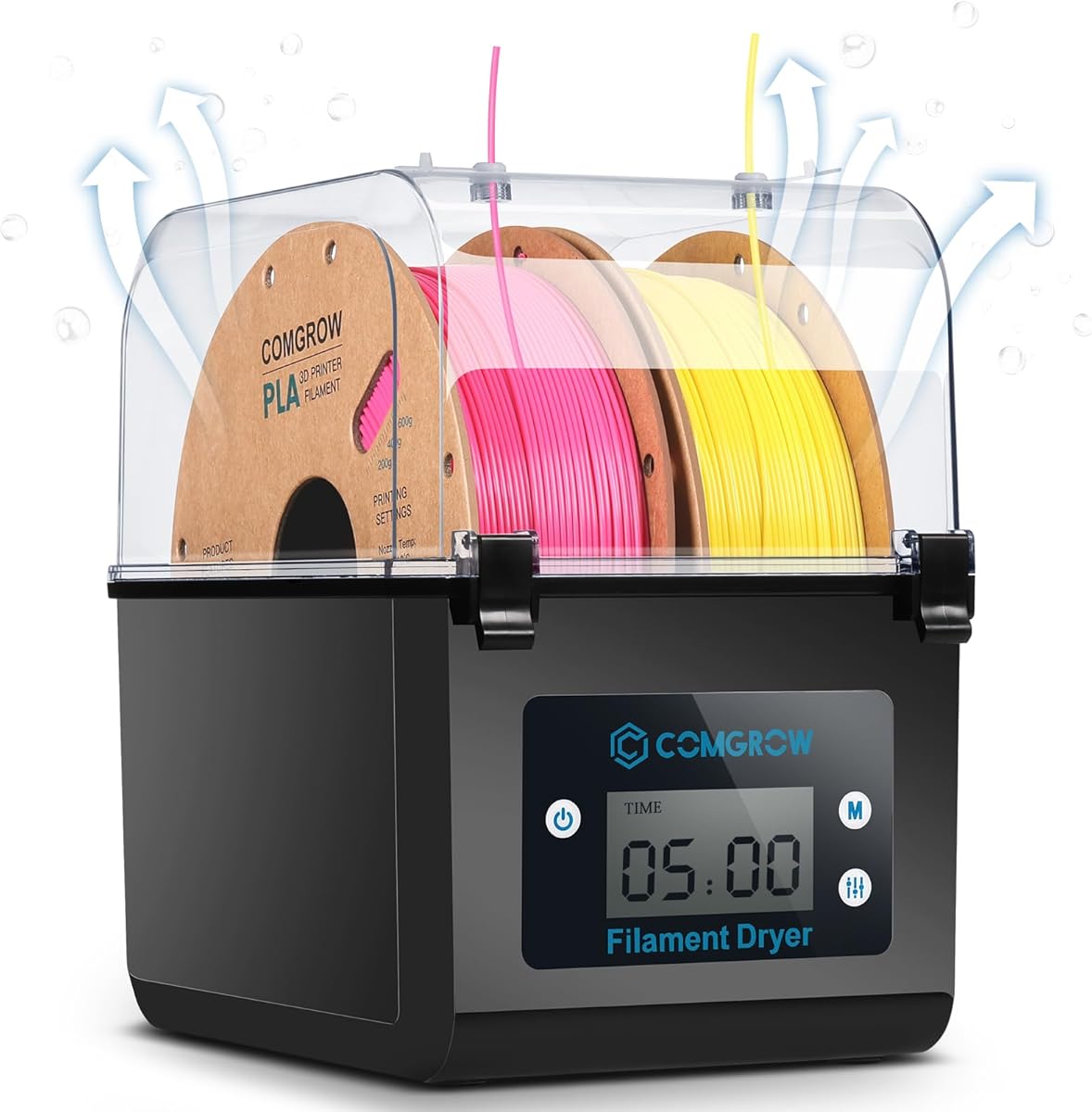
The Comgrow dryer offers a solid entry point for those new to filament drying. With a 4.4 rating, it provides essential moisture removal without breaking the bank. It is designed to keep filament dry during printing and storage efficiently.
We may earn a commission when you buy through this link, at no additional cost to you.
Its key strength lies in the practical storage volume which accommodates two rolls of 1kg spools. The silicone cable sheath outlet ensures smooth feeding while maintaining a seal. Users can adjust temperature and duration easily via the LCD screen.
The main limitation is the maximum temperature of 50 degrees Celsius which may not suffice for very hygroscopic materials. Additionally features are basic compared to higher-end models. However for beginners using PLA or PETG, this is perfectly adequate.
We suggest this dryer for users on a budget or with moderate printing needs. It effectively prevents common moisture issues like stringing. It is a reliable choice for maintaining filament quality without advanced features.
The box holds two spools comfortably ensuring you have enough filament for multi-day prints.
Touch buttons and a clear LCD make setup straightforward for any experience level.
We may earn a commission when you buy through this link, at no additional cost to you.
The SUNLU S1 Plus upgrades traditional drying with a fan design to enhance airflow. It carries a 4.3 rating and is popular for its speed in removing moisture. The visual display helps you monitor conditions actively.
We may earn a commission when you buy through this link, at no additional cost to you.
The fan design is the key advantage allowing excess water to discharge quickly. This reduces the impact of wet weather on printing. The adjustable temperature range covers most common materials ensuring versatile use.
While effective it holds fewer spools than multi-unit dryers. The timer options are basic compared to advanced models. For single spool users it remains a strong contender.
This dryer is ideal for casual printers needing quick maintenance. The humidity display adds value for monitoring. It balances cost and function well for standard printing.
The added fan pushes moist air out faster than passive heated units.
The LCD screen displays temperature time and humidity for real-time tracking.
We may earn a commission when you buy through this link, at no additional cost to you.
The SUNLU S4 is designed for professional workflows requiring robust moisture control. It earns a 4.5 rating for its reliability and capacity. The 350W heater ensures rapid and even drying across four spools.
We may earn a commission when you buy through this link, at no additional cost to you.
Its 350W PTC heater offers 50% higher efficiency than previous models. The eight exit holes allow simultaneous feeding to multiple printers. This setup is ideal for print farms or busy studios.
The unit is heavy and takes up significant desk space. The price reflects its professional features. However for high-volume users it delivers unmatched convenience.
We recommend this for print farms needing continuous operation. The long timer allows unattended drying. It is a top choice for serious practitioners.
The 350W heater provides consistent heat that dries filament faster than standard units.
Eight exit holes let you run multiple printers from one drying unit seamlessly.
We may earn a commission when you buy through this link, at no additional cost to you.
This Creality model simplifies drying with preset settings for common filaments. With a 4.4 rating it is known for ease of use. The 360 degree hot air ensures uniform drying throughout the chamber.
We may earn a commission when you buy through this link, at no additional cost to you.
The one-key settings for 12 filament types save time. The humidity monitor helps track progress accurately. The touch screen is intuitive and supports Fahrenheit and Celsius switching.
While it only holds two spools it focuses on precision. The heating power is moderate compared to high wattage units. This is suitable for users prioritizing convenience.
This dryer fits users who want quick setup. The humidity monitor helps avoid guesswork. It balances features with usability for home studios.
Presets remove the need to manually calculate temps for different materials.
Real-time humidity data ensures you know exactly when filament is dry enough.
We may earn a commission when you buy through this link, at no additional cost to you.
The Polymaker Polydryer offers an integrated solution for drying and storage. Rated 4.3 it focuses on protecting filament between prints. The design minimizes exposure to ambient moisture effectively.
We may earn a commission when you buy through this link, at no additional cost to you.
Its built-in hygrometer provides clear status tracking without guesswork. The integrated approach combines heat sealing and desiccant for complete protection. This ensures filament stays ready for immediate use.
It does not hold as many spools as larger models. The design is specific to Polymaker standards. However it provides excellent reliability for standard workflows.
We recommend this for users valuing filament preservation. The hygrometer adds confidence. It is a strong choice for consistent results.
Moving from drying to storage without breaking the seal keeps moisture out.
Internal sensors allow you to track humidity levels precisely.
We may earn a commission when you buy through this link, at no additional cost to you.
This Creality SE model focuses on efficient single spool drying. It holds a 4.3 rating for its consistent performance. The upgraded PTC solution heats up quickly and evenly throughout the chamber.
We may earn a commission when you buy through this link, at no additional cost to you.
Thermal insulation keeps the outer shell safe to touch. The temperature range up to 65 degrees handles most common materials well. The knob interface is straightforward and easy to adjust.
It is limited to one spool so not ideal for batch drying. The interface is simpler than touch screen models. However for single unit drying it works well.
This dryer suits users needing simple reliable heat. The insulation prevents burns. It is great for small workspaces.
Inner wall insulation keeps the exterior cool and safe during operation.
Adjustable settings allow fine-tuned drying for sensitive materials.
We may earn a commission when you buy through this link, at no additional cost to you.
The SUNLU S4 supports large batches with four spool capacity. It scores 4.6 for reliability and efficiency. Three circulation fans ensure consistent temperature across the entire area.
We may earn a commission when you buy through this link, at no additional cost to you.
It handles materials from PLA to PC effectively. The high capacity allows long runs without reloading. The design supports even drying across different spool positions.
The size is large and demands desk space. The cost is higher than basic options. For high-volume users the capacity is invaluable.
We recommend this for print farms needing volume. The fans improve efficiency. It is a robust choice for demanding setups.
Three fans maintain even heat distribution for uniform drying results.
Supports standard spools and can be modified for larger rolls if needed.
We may earn a commission when you buy through this link, at no additional cost to you.
The SUNLU SP2 is unique for holding 3kg spools directly. It has a 4.4 rating for its speed and capacity. The heating reaches 70 degrees in 15 minutes for fast processing.
We may earn a commission when you buy through this link, at no additional cost to you.
Its detachable base allows easy storage after drying. The humidity monitor keeps you informed during cycles. This design supports both drying and storage needs.
Setup can be complex for first-time users. Maintenance is needed to keep seals tight. For large spool owners it is essential.
We suggest this for users with bulk filament. The speed saves time. It handles large rolls efficiently.
Designed specifically for 3kg rolls that standard units cannot fit.
Reaches effective drying temps in 15 minutes to reduce wait times.
We may earn a commission when you buy through this link, at no additional cost to you.
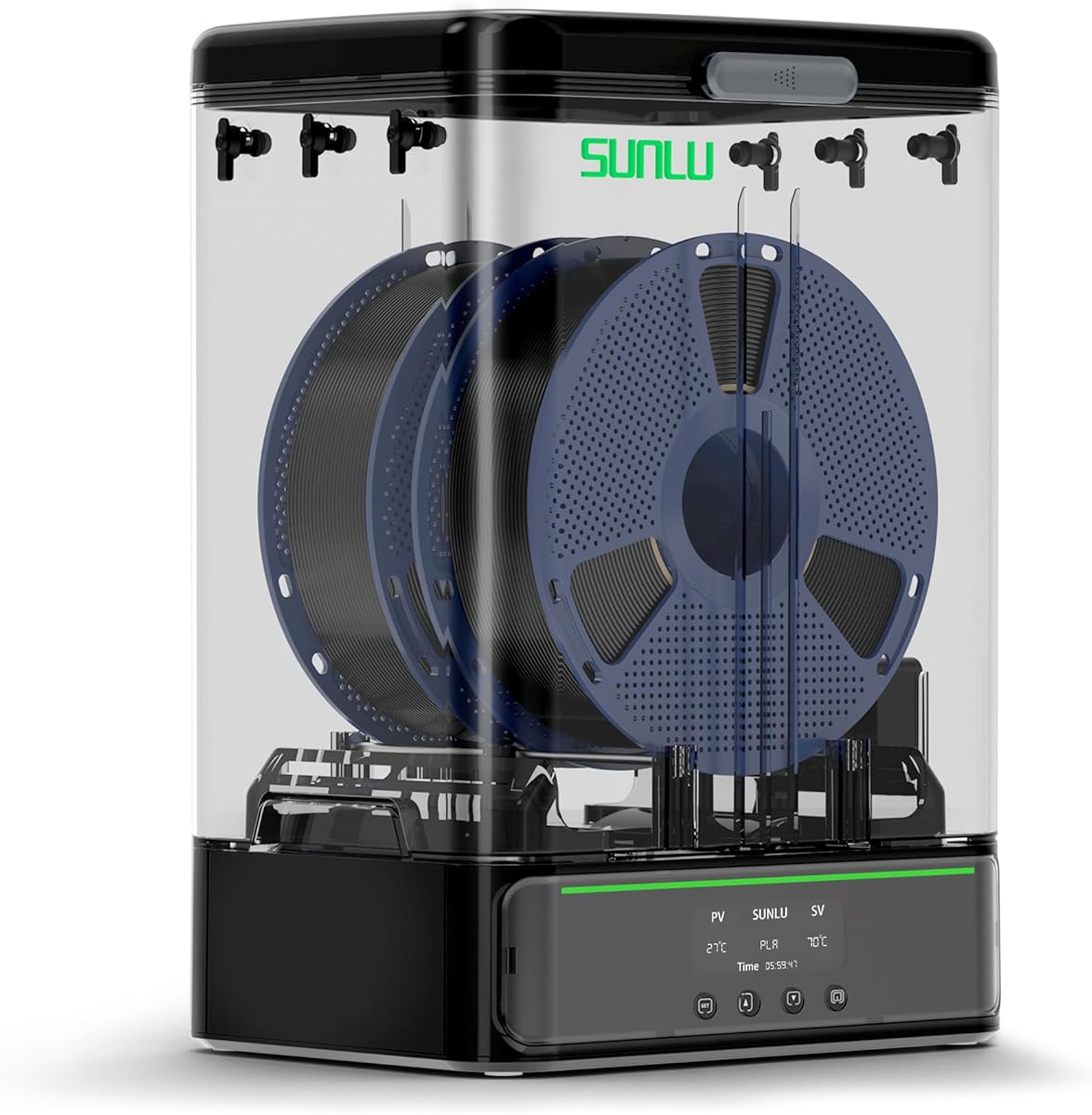
The SUNLU S2 offers solid basic drying performance at an entry price. It rates 4.3 for reliability. The built-in spindle ensures filament rotates for even heat distribution.
We may earn a commission when you buy through this link, at no additional cost to you.
Its large capacity handles standard spools well. The translucent lid lets you check progress without opening. This helps maintain internal temperature during checks.
It is not the fastest for heavy moisture but sufficient for maintenance. The touch interface is simple. For budget users it works well.
We recommend this for beginners needing moisture control. The spindle helps avoid uneven drying. It is a great first dryer.
The spindle rotates filament continuously to prevent cold spots during drying.
A translucent lid allows monitoring without exposing the filament to humid air.
We may earn a commission when you buy through this link, at no additional cost to you.
Choosing the right dryer requires understanding your printing needs and materials. This guide outlines key factors to consider before purchasing a moisture control system.
Consider how many spools you typically need to dry at once. Single spool dryers are compact while multi-unit systems support larger batches. Measure your desk space to ensure the unit fits comfortably.
Choose capacity based on print volume to avoid frequent reloads and maximize efficiency.
Different materials require different temperatures for effective drying. Basic PLA works at lower temps while ABS or Nylon needs higher heat. Ensure the dryer covers the range needed for your specific materials.
Select a unit with adjustable settings to accommodate diverse filament types.
PTC heaters offer safer and faster warming compared to standard heating pads. Look for models that distribute heat evenly to avoid hot spots. Fans can also help circulate air for uniform results.
Prioritize PTC or fan-assisted systems for reliable consistent drying.
The dryer should double as storage to keep filament dry between prints. Sealed enclosures prevent moisture re-absorption. Good sealing gaskets ensure the environment remains controlled.
Look for units that allow you to move from drying to storage without breaking the seal.
User interfaces vary from simple knobs to touch screens. Choose a control method you find intuitive. Clear displays for temperature and time help track progress effectively.
Opt for a user-friendly interface to simplify daily operations and reduce errors.
Timers allow unattended drying for up to 99 hours. Preset options for common filaments save setup time. These features add convenience for regular users.
Check for long timer ranges and presets that match your common materials.
A durable unit ensures longevity in a workshop environment. Look for sturdy materials and reliable electrical components. Warranty support can also indicate manufacturer confidence.
Invest in a well-built model to avoid frequent replacements and repairs.
Prices range from budget-friendly to premium. Consider the features you need versus those that are nice to have. Value lies in performance and longevity over time.
Balance your budget against required capacity and features to find the best fit.
Start by setting the correct temperature based on your filament type. PLA usually needs around 45 degrees while ABS may require 70 degrees. Avoid overheating as this can deform the spool or degrade the material.
Place the spool securely in the holder ensuring the filament feeds smoothly through the exit tube. Close the lid tightly to maintain the sealed environment. Turn on the dryer and set your desired timer duration.
After drying check the filament condition visually. If the print shows improved quality you are ready. Clean the unit occasionally by wiping dust and checking gaskets. Store filament dry in the dryer or sealed bags to maintain results.
Drying times vary by material and moisture level. PLA often needs 4 to 6 hours while Nylon may require 12 or more. Always check the manufacturer's recommendations and use the timer features.
Most dryers are designed for temporary drying and short-term storage. For long-term storage use vacuum bags. Leaving filament inside for too long might dry out lubricants in TPU.
PLA absorbs moisture slowly but it helps prevent stringing. If you print often or live in a humid area a dryer is beneficial. For occasional printing storage in a sealed box may suffice.
PETG typically dries well at 60 degrees Celsius. Avoid higher temperatures as PETG can become too soft. Always verify specific settings from your filament manufacturer.
Not all dryers use desiccant. Models that include it will need replacements over time. Check the manual for maintenance schedules to ensure continued moisture protection.
A dryer can remove moisture but cannot restore chemical degradation. If filament is brittle it may be too old. Use drying for filament that has just been exposed to humidity.
Dry filament prints without stringing or bubbles. You can check the spool weight before and after drying. Moisture reduction indicates successful drying.
We explored ten excellent dryers from budget options to premium multi-spool systems. The Creality 4-Spool model stands out for high volume while the SUNLU S2 remains great for entry users.
Prioritize capacity and temperature range based on your most common materials. If you work with engineering filaments invest in higher wattage models for better results.
Prices and availability change so check current listings before buying. The right dryer will extend filament life and improve print quality significantly.