
LONELY BINARY Logic Analyzer Kit
4.2Editor score
Eight channel twenty four megahertz capture
Includes breakout boards and accessories
Compatible with Windows Mac and Linux
This guide compares the top ten logic analyzers for electronics projects, evaluating channels, speed, and software to help you choose the right debugging tool.
Modern electronics development requires precise signal monitoring to ensure circuits function as intended. A quality logic analyzer captures digital states over time, allowing engineers and hobbyists to visualize data transmission and timing issues effectively.
We evaluated ten prominent models based on channel count, sampling rates, protocol support, and software usability. Each device was assessed for its ability to handle common embedded systems tasks and its ease of integration with existing workflows.
Every selection highlights specific strengths like portability or advanced decoding features. Note that market availability and pricing fluctuate frequently, so verify current stock and offers before making your final purchase decision.
4.2Editor score

4.5Editor score
4.8Editor score
The following table provides a side-by-side comparison of all ten selected logic analyzers. Review each specification carefully to understand how sampling rates, channel counts, and memory depths vary across different price points and use cases.




The LONELY BINARY Logic Analyzer Kit offers an accessible entry point for students and hobbyists needing reliable digital signal monitoring. With eight channels and a twenty four megahertz sampling rate, it captures essential data for common embedded tasks without overwhelming complexity.
We may earn a commission when you buy through this link, at no additional cost to you.
Its design emphasizes ease of use through included breakout boards and logic level expansion adapters. These accessories allow secure connections to breadboards and microcontrollers, reducing the risk of loose wires during testing. The kit also provides both USB-A and Type-C cables for broader device compatibility.
While it lacks the raw speed of high-end units, this device handles I2C, SPI, and UART debugging effectively. The included storage case keeps components organized and protected, making it ideal for portable projects or classroom environments where equipment must travel frequently.
Buyers seeking a cost-effective tool for foundational electronics work will find this kit sufficient. It balances functionality and convenience well, though users requiring faster sampling or advanced protocol analysis may eventually need to upgrade to a more robust solution.
The package includes ten test clips, five alligator clips, and jumper wires, ensuring you have everything needed for immediate use without additional purchases.
Dual USB connectivity ensures the analyzer works seamlessly with older desktops and modern laptops, providing hassle-free plug-and-play across Windows, Mac, and Linux systems.
We may earn a commission when you buy through this link, at no additional cost to you.
The LA1010 USB Logic Analyzer stands out for its balance of performance and usability in mid-range applications. Featuring sixteen input channels and a one hundred megahertz sampling rate, it provides sufficient bandwidth to debug complex microcontroller systems and digital circuits efficiently.
We may earn a commission when you buy through this link, at no additional cost to you.
Its bundled KingstVIS software offers real-time signal visualization and decodes over thirty standard protocols like I2C, SPI, and CAN. This capability transforms raw waveforms into human-readable data, significantly accelerating the debugging process for embedded engineers and hobbyists alike.
The device supports Windows, macOS, and Linux with automatic driver installation, ensuring minimal setup time. Its portable design and low power consumption make it suitable for long-term signal monitoring or field testing where battery life or mobility matters.
Professionals looking for a reliable tool that handles diverse protocols without breaking the bank will appreciate this model. While the software interface may feel less modern than competitors, its functional depth and hardware reliability justify its place as a top recommendation.
With support for decoding over thirty standard protocols, the device extracts communication data efficiently, allowing engineers to focus on logic errors rather than raw signal interpretation.
The analyzer works seamlessly across Windows, macOS, and Linux environments, ensuring that teams using different operating systems can share tools without compatibility issues.
We may earn a commission when you buy through this link, at no additional cost to you.
The Saleae Logic Pro 16 represents the pinnacle of professional logic analysis tools, offering unmatched speed and memory capacity. With a digital sample rate up to five hundred megasamples per second and over ten billion digital sample capacity, it captures fleeting signal anomalies that lower-end devices miss entirely.
We may earn a commission when you buy through this link, at no additional cost to you.
Its dual-mode support allows mixed signal inputs, enabling simultaneous analog and digital analysis on the same channels. This flexibility is crucial for debugging modern embedded systems where analog noise affects digital logic. The ultra-portable design ensures it fits easily into a workbench or field kit.
The accompanying software provides an intuitive interface that simplifies complex data interpretation, though it relies on a subscription model. Cross-platform support for Mac, Windows, and Linux ensures accessibility across diverse development environments, making it ideal for teams requiring consistent tools.
Users demanding precision for high-speed protocols or critical system validation should consider this premium option. While the initial cost is significant, the reliability and performance improvements can save valuable engineering time and reduce debugging frustration in demanding applications.
The device stores over ten billion digital samples using PC memory and USB 3.0 connectivity, allowing extended capture sessions without losing data resolution or timing accuracy.
Compatible with Mac, Windows, and Linux, the software ensures that users can maintain workflow consistency regardless of their operating system preference.
We may earn a commission when you buy through this link, at no additional cost to you.
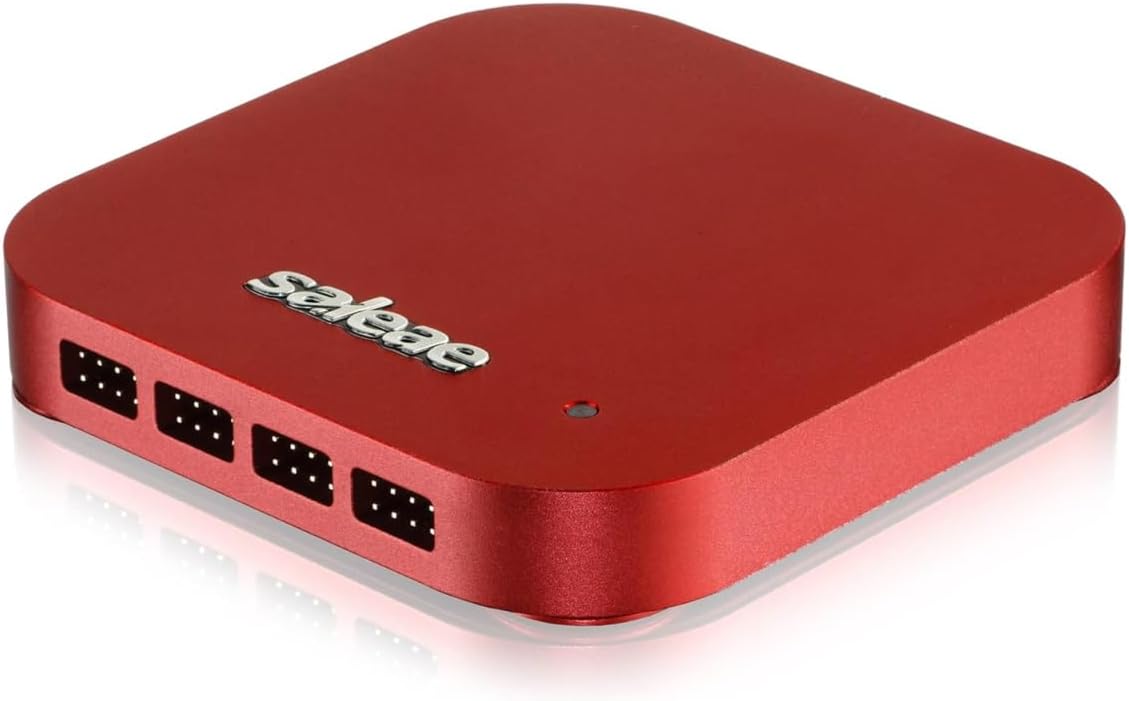
The Saleae Logic Pro 8 delivers professional-grade performance in a more compact form factor, making it ideal for projects with fewer simultaneous signals. It retains the same five hundred megasamples per second digital sample rate as its sixteen-channel counterpart, ensuring precise timing analysis for high-speed protocols.
We may earn a commission when you buy through this link, at no additional cost to you.
Its eight digital and analog input channels support mixed signal testing, allowing users to capture correlated data across domains. The ultra-portable design minimizes bench clutter while maintaining the robust build quality associated with the Saleae brand, ensuring durability during daily use.
Users benefit from the same intuitive software interface and cross-platform compatibility found in the larger Pro 16 model. While channel count is lower, this trade-off often suits embedded developers focusing on single microcontroller debugging or limited I/O tasks.
For those needing top-tier speed but not maximum channel count, this unit offers a balanced compromise. It maintains the reliability and ease of use expected from premium tools, though the cost remains substantial compared to entry-level alternatives.
The Logic Pro 8 uses the same intuitive software suite as the Pro 16, ensuring that users transition between models without relearning tools or workflows.
With mixed signal input support, the analyzer can handle both analog and digital signals simultaneously, providing deeper insight into system interactions.
We may earn a commission when you buy through this link, at no additional cost to you.
This USB Logic Analyzer provides an accessible way to monitor digital signals, featuring compatibility with Saleae Logic Analyzer software and PulseView. Its eight channels and adjustable sampling rates up to twenty four megahertz allow users to tailor performance to specific project needs without excessive cost.
We may earn a commission when you buy through this link, at no additional cost to you.
The device supports common communication protocols like UART, SPI, and IIC, enabling efficient debugging of Arduino, ARM, and FPGA projects. Adjustable voltage thresholds help accommodate different logic levels, though the range is optimized for standard three-point-three and five-volt systems.
While the hardware design is simple, the software compatibility expands its utility significantly. Users familiar with open-source analysis tools can leverage existing workflows, making this a practical choice for educational purposes or prototyping environments.
Buyers seeking a budget-friendly option that does not sacrifice essential protocol support will find this unit valuable. However, those requiring robust build quality or advanced features may need to consider more specialized devices.
Sampling rates can be adjusted from five hundred kilohertz up to twenty four megahertz, allowing users to match the capture speed to the specific signal requirements.
Automatic analysis for UART, IIC, and SPI protocols simplifies debugging, reducing the need for manual waveform interpretation.
We may earn a commission when you buy through this link, at no additional cost to you.
The DSLogic Plus offers versatile dual-mode support for both streaming and buffer capture, accommodating a wide range of analysis scenarios. With up to four hundred megahertz sampling in buffer mode and sixteen digital channels, it handles complex high-speed interfaces effectively.
We may earn a commission when you buy through this link, at no additional cost to you.
Its two hundred fifty six megabits of on-board SDRAM allows deep captures in buffer mode, while stream mode transfers data directly to PC memory for long-duration monitoring. This flexibility ensures the device adapts to transient glitches or sustained protocol monitoring equally well.
DSView software is open-source and supports nearly a hundred protocol decoders, providing extensive analysis capabilities. Shielded fly wires and an aluminum case improve signal integrity and waveform clarity, essential for accurate diagnostics in noisy environments.
Engineers needing high-speed capabilities and flexible capture modes will find this unit powerful. The open-source ecosystem offers customization opportunities, though users should expect a steeper learning curve compared to proprietary commercial solutions.
The analyzer supports both stream and buffer modes, allowing users to choose between long sample duration and high sample rates depending on their specific task.
DSView is compatible with Windows, macOS, and Linux, and its open-source nature allows community contributions and custom protocol development.
We may earn a commission when you buy through this link, at no additional cost to you.
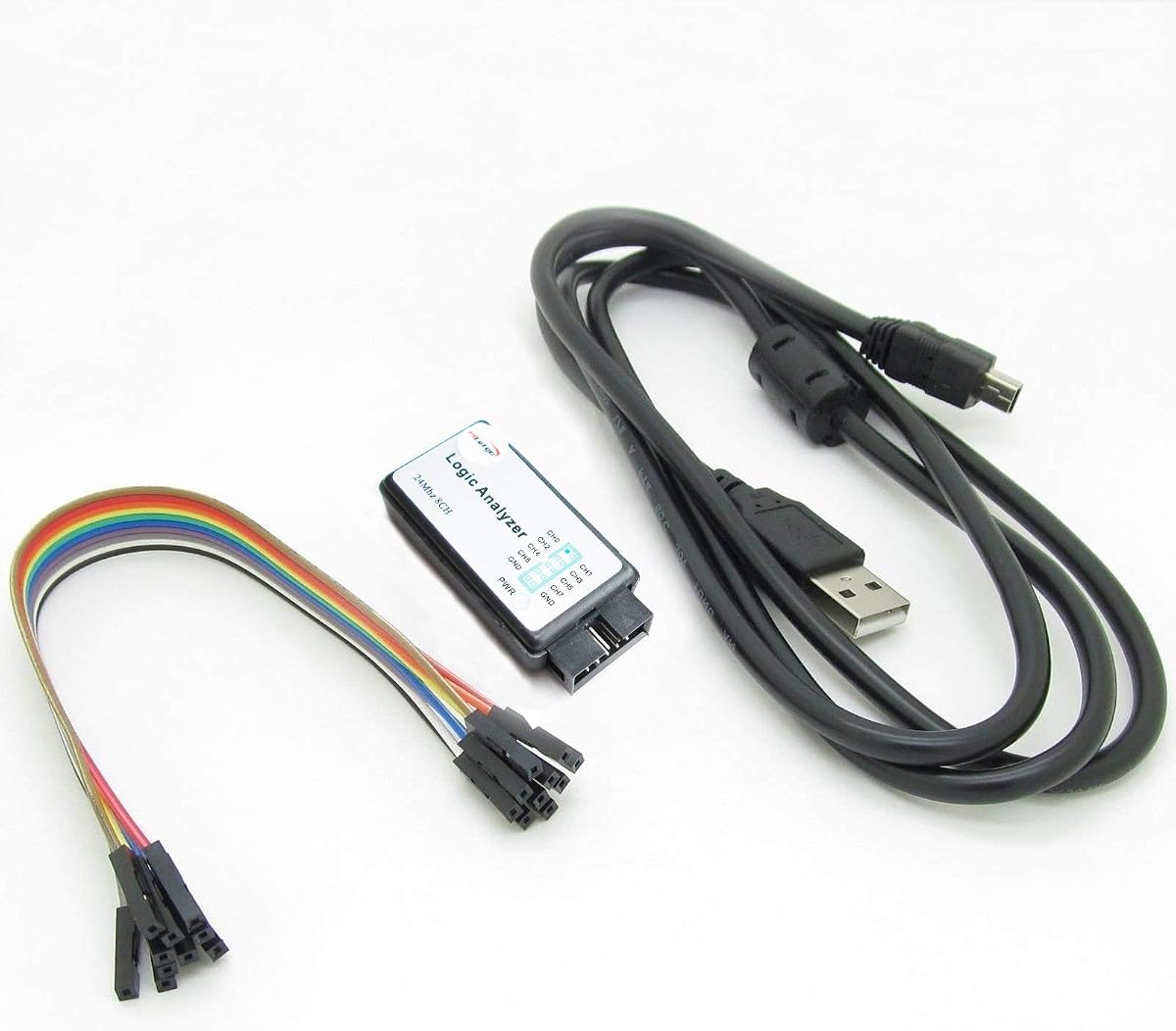
This HiLetgo USB Logic Analyzer Device provides an accessible tool for debugging common digital protocols. Its eight channels and twenty four megahertz sampling rate cover essential needs for UART, IIC, and SPI analysis, while the included EMI ferrite ring helps reduce cable interference.
We may earn a commission when you buy through this link, at no additional cost to you.
The input voltage range is carefully specified to ensure compatibility with standard logic levels, preventing accidental damage to sensitive circuits. Adjustable thresholds allow users to adapt to slight voltage variations across different components, ensuring accurate high-low state detection.
Construction is functional and straightforward, prioritizing cost-efficiency over premium materials. It performs reliably in controlled environments, making it suitable for hobbyists or educational settings where budget constraints are a priority.
Users looking for a no-frills solution to verify basic digital signals will find this unit adequate. While it lacks the speed or software features of higher-end models, it offers dependable performance for routine debugging tasks.
The USB cable includes an EMI ferrite ring, which reduces electromagnetic interference and helps ensure cleaner signal captures during analysis.
Voltage inputs range from negative zero point five volts to five point two five volts, accommodating common logic voltage standards without additional level shifting.
We may earn a commission when you buy through this link, at no additional cost to you.
The Logic 8 (Black) provides a streamlined approach to logic analysis with eight digital and analog inputs. Offering a digital sample rate up to one hundred megasamples per second, it captures essential timing data accurately for most embedded development tasks.
We may earn a commission when you buy through this link, at no additional cost to you.
Its software interface is noted for ease of use, helping users quickly visualize signals and decode protocols like SPI and I2C. The device stores over ten billion digital samples using PC memory, ensuring ample capacity for extensive trace analysis.
Cross-platform compatibility with Mac, Windows, and Linux ensures that diverse teams can utilize this tool without friction. The ultra-portable design allows it to fit easily in laptop bags, making it suitable for field debugging or collaborative work sessions.
Buyers needing a dependable and easy-to-use tool for moderate-speed protocols will appreciate this model. While channel count is limited, its performance and software quality make it a strong candidate for focused development work.
The analyzer decodes SPI, I2C, and over twenty three other protocols, simplifying the process of identifying communication errors in embedded systems.
With over ten billion samples of digital data available via PC memory, the device supports long trace captures without running out of onboard buffer space.
We may earn a commission when you buy through this link, at no additional cost to you.
This USB Logic Analyzer offers extensive capture capabilities with sixteen channels and up to four hundred megahertz sampling rates. Its sixteen gig sample depth in stream mode and two hundred fifty six megabits of SDRAM in buffer mode ensure users can record both short bursts and long sequences.
We may earn a commission when you buy through this link, at no additional cost to you.
The device supports nearly a hundred protocol decoders via DSView software, which is open-source and compatible with Windows, macOS, and Linux. Shielded wires help maintain signal integrity, providing cleaner waveforms that simplify debugging efforts.
Adjustable thresholds allow customization to specific voltage requirements, enhancing compatibility across diverse hardware. This flexibility makes it a versatile choice for engineers working with mixed voltage systems or non-standard protocols.
Users needing deep memory for transient event capture will value this unit's technical specifications. While the software interface may require some learning, the hardware capabilities support professional-level analysis in embedded development contexts.
Stream mode allows up to sixteen gig samples of depth, enabling long-duration signal monitoring without losing critical timing data.
DSView is open-source and available on GitHub, allowing users to customize features and contribute to the development of the software.
We may earn a commission when you buy through this link, at no additional cost to you.
The Analog Discovery 3 consolidates multiple lab instruments into a single USB-powered device, offering logic analysis alongside oscilloscope and waveform generation capabilities. Its sixteen digital I/O channels support up to one hundred twenty five MS/s, enabling detailed digital signal monitoring.
We may earn a commission when you buy through this link, at no additional cost to you.
Beyond logic analysis, the device includes programmable power supplies and a spectrum analyzer, making it a comprehensive solution for prototyping. SDK support for C, C++, and Python allows automation and custom instrument control, which is invaluable for advanced testing environments.
Its high differential channel resolution and wide input range ensure accurate measurement across varied signal types. This versatility reduces bench clutter, offering a compact alternative to traditional multi-device setups.
Users needing a unified tool for analog and digital work will find this device highly effective. While the breadth of features requires a learning curve, it significantly enhances workflow efficiency in complex electronics projects.
The unit combines oscilloscope, logic analyzer, and power supply functions, reducing the need for multiple separate instruments on the workbench.
Software development kits are available for languages like Python and C++, allowing users to script automated tests and integrate the device into custom workflows.
We may earn a commission when you buy through this link, at no additional cost to you.
Selecting the right logic analyzer depends on your specific project requirements, budget, and technical expertise. Consider these key factors to ensure the device meets your analysis needs.
The number of channels determines how many signals you can capture simultaneously. For simple microcontroller debugging, eight channels often suffice. Complex systems like FPGAs or buses may require sixteen or more to capture all relevant lines at once.
Choose a model with enough channels to cover your most critical signals without needing to probe multiple times.
Sampling rate defines how many data points are captured per second. Higher rates allow accurate reconstruction of fast digital signals. For protocols like SPI or UART, twenty four to one hundred megahertz usually works, while high-speed interfaces need five hundred megahertz or more.
Match the sampling rate to the fastest signal frequency you need to analyze to prevent aliasing or data loss.
Memory depth dictates how long the analyzer can record at a given sampling rate. Deep memory allows capturing long sequences or rare glitches without dropping samples. Buffer modes store data onboard, while stream modes rely on PC storage.
Prioritize units with deep memory if you need to trace long protocol sequences or intermittent errors.
Software tools visualize and interpret captured data. Look for platforms that support protocol decoders like I2C or UART to convert raw waveforms into readable data. Cross-platform compatibility ensures your team can use the device regardless of OS.
Verify that the software is intuitive and offers sufficient features for your analysis requirements.
Modern analyzers use USB for data transfer and power. USB 3.0 provides faster throughput than USB 2.0, crucial for high-speed streaming. Check connector types like Type-C for modern laptop compatibility.
Ensure the connection standard aligns with your available ports to avoid adapter dependency.
Logic analyzers have specific input voltage ranges. Some devices accept five-volt signals, while others are designed for lower logic levels. Mismatched voltages can damage the hardware or produce inaccurate readings.
Check voltage tolerance to ensure safe connection with your specific microcontrollers or sensors.
Included accessories like probe clips and breakout boards affect usability. High-quality shielded cables reduce noise interference. Portable cases help protect equipment during transport.
Invest in models with robust accessories to ensure reliable connections and long-term durability.
Some analyzers support firmware updates or plugin modules for additional features. Open-source platforms often allow custom decoders. This future-proofs your investment as project requirements evolve.
Opt for devices with flexible ecosystems if your work may expand into new protocols.
To begin using your logic analyzer, connect it to your computer via USB and install any necessary drivers or software. Launch the application to verify that the device is recognized before connecting any circuits.
Connect probe clips to the target circuit nodes carefully, ensuring ground is properly established to avoid shorts. Configure sampling rates and thresholds in the software to match your signal characteristics for accurate capture.
Store the device and accessories in a dry, cool place when not in use. Inspect cables regularly for wear and keep probe tips clean to maintain signal integrity and prevent connection issues during future sessions.
A logic analyzer captures digital signals to visualize data transmission and timing behavior. It helps identify logic errors or protocol violations by displaying waveforms and decoded communication data, which simplifies debugging embedded systems.
For most basic Arduino or microcontroller tasks, eight channels are sufficient. This allows you to monitor GPIO pins, communication lines like SPI or I2C, and control signals without needing to switch probes repeatedly.
A logic analyzer is specialized for digital signals and cannot capture analog waveforms. However, some models combine both functions, offering a cost-effective way to analyze mixed-signal circuits without separate equipment.
Sampling rate determines how accurately the device records fast digital transitions. If the rate is too low relative to your signal frequency, you may miss critical edges or misinterpret timing relationships between signals.
Open-source tools like DSView or PulseView offer extensive protocol support and customization. While they may lack polished interfaces, they are widely used and reliable for professional debugging when paired with capable hardware.
Ensure you use analyzers with sufficient voltage tolerance or include level shifters when working with higher voltages. Proper grounding and avoiding accidental shorts during probing also help protect the hardware from damage.
Price is driven by sampling rate, channel count, memory depth, and software capabilities. Higher-performance units with advanced decoding and mixed-signal support naturally command higher costs than entry-level hobbyist models.
Most modern analyzers include decoders for standard protocols like I2C and SPI. However, verifying protocol support in the specifications ensures the device meets your specific communication needs before purchase.
This guide reviewed ten logic analyzers ranging from affordable hobbyist kits to professional-grade instruments. Each model offers distinct advantages depending on your specific needs, whether you prioritize channel count, speed, or software flexibility.
Prioritize features that align with your common tasks. If you frequently debug high-speed protocols, investing in higher sampling rates is wise. For simple prototyping, budget-friendly models often provide ample functionality without unnecessary expense.
Always verify the latest product details and availability before purchasing. Prices and stock levels fluctuate, so confirming current offers ensures you secure the best value for your electronics development requirements.