
6-Band Signal Generator 100KHz-150MHz
4.0Editor score
150 MHz max frequency
AM FM modulation included
Low phase noise design
This guide compares the top 10 Amfm Signal Generator models for 2026 based on frequency range, modulation types, accuracy, and build quality to help you choose.
Finding the right Amfm Signal Generator is essential for anyone working with radio frequency testing or electronic calibration. These devices help professionals and hobbyists alike generate precise signals needed for various diagnostic tasks in modern electronics.
We evaluated ten top-rated models based on their frequency ranges, modulation capabilities, build quality, and user feedback. Our comparison focuses on performance reliability and ease of use to ensure you find a device that fits your specific technical requirements.
Each pick below highlights key features and potential limitations so you can make an informed decision. Remember that product availability and pricing can change over time, so always verify current details before finalizing your purchase.
4.0Editor score

5.0Editor score

5.0Editor score
The following table provides a side-by-side comparison of all ten models to help you quickly identify key specifications and features for each device.




The UNI-T UTG962E stands out as the top choice for professionals seeking a reliable Amfm Signal Generator. With a perfect 5.0 rating, this device delivers high performance in a compact form factor suitable for both lab and field use.
We may earn a commission when you buy through this link, at no additional cost to you.
Its 60 MHz frequency output and 200 MS/s sample rate ensure precise waveform generation. The dual channels support sine, square, ramp, and arbitrary waveforms, while AM, FM, and PM modulation options cater to diverse testing scenarios.
While the price is higher than basic models, the versatility justifies the investment. Users should note that mastering the full range of features may require some time spent reading the manual and experimenting with settings.
Ideal for electronics enthusiasts and engineers, this generator combines power with portability. Its inclusion of cables and adapters makes it ready to use right out of the box for immediate testing tasks.
The 200 MS/s sample rate allows for detailed signal reproduction which is critical for accurate diagnostics in complex circuits.
Support for AM FM and PM modulation ensures compatibility with a wide range of radio frequency testing protocols and standards.
We may earn a commission when you buy through this link, at no additional cost to you.
The OWON DGE2035 offers a strong alternative for users needing dual-channel capabilities with detailed visual feedback. Its 4.2 rating reflects solid performance for lab testing and educational training purposes across various electronic applications.
We may earn a commission when you buy through this link, at no additional cost to you.
With a 14-bit resolution and 125 MSa/s sampling rate, it provides stable signal generation. The 3.6 inch TFT LCD displays real-time waveforms making it easy to adjust settings without external tools or monitors.
One limitation is the lower 35 MHz frequency limit compared to higher-end models. Additionally, users relying on PC control may need to manage software connections which can complicate quick standalone field tests.
This device is well-suited for research labs and educational settings where visualization and precision are prioritized. Its lightweight design ensures easy transport between workstations or testing environments without significant physical burden.
The color TFT screen allows technicians to monitor waveform status instantly which reduces setup time during critical measurement tasks.
USB PC control enables automation of test sequences which enhances workflow efficiency in larger production or research environments.
We may earn a commission when you buy through this link, at no additional cost to you.
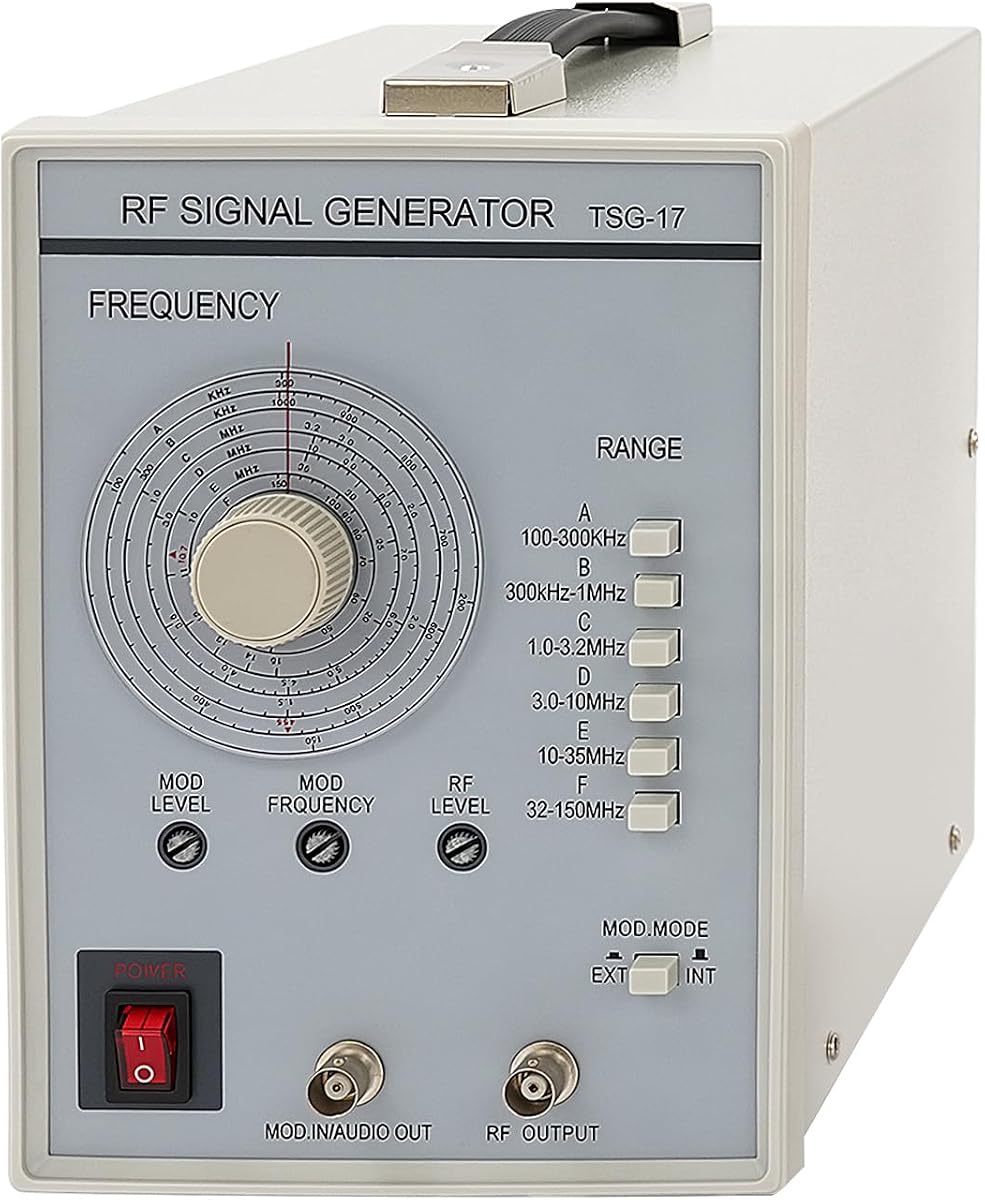
For budget-conscious users, the 6-Band Signal Generator provides excellent value with a broad frequency range and reliable performance. It is ideal for basic radio testing and maintenance tasks where high-end features are not strictly necessary.
We may earn a commission when you buy through this link, at no additional cost to you.
The device covers 100 kHz to 150 MHz across six bands allowing flexible signal generation. Its low phase noise ensures signal purity which is vital for testing environments requiring high quality and minimal interference.
While it lacks arbitrary waveform support, its straightforward design makes it easy to operate. The metal and plastic construction ensures durability against impact and corrosion during regular use in workshops or field sites.
This generator is perfect for hobbyists or technicians needing a simple tool for routine checks. The assembly-free structure saves time allowing users to connect power and start testing immediately without complex setup steps.
The metal casing and plastic spraying process provide scratch resistance which extends the lifespan of the device in demanding work conditions.
Clear markings and knob layouts allow users to quickly adjust frequency bands without requiring extensive technical training or reference manuals.
We may earn a commission when you buy through this link, at no additional cost to you.
The SG-A9 model offers an impressive frequency range spanning from 35 MHz to 4400 MHz which is rare at this price point. It serves well for users needing broad RF coverage without investing in expensive laboratory equipment.
We may earn a commission when you buy through this link, at no additional cost to you.
It supports both single frequency and sweep modes providing flexibility for different testing scenarios. The power off memory feature saves parameters so you can resume work at the previous frequency after turning the device back on.
However, users should expect basic sine wave output with some noise compared to higher-end digital generators. The 3.7 rating suggests variability in performance which might not suit critical precision applications in sensitive circuits.
Ideal for hobbyists or basic RF exploration, this generator is easy to power via USB or a mobile bank. Its lightweight design makes it portable though it is best used for general signal tracing rather than precise calibration.
Coverage up to 4400 MHz allows testing of high frequency components which is useful for modern wireless communication device diagnostics.
Ability to run off a mobile charger or computer USB port makes it easy to use in field locations without access to wall outlets.
We may earn a commission when you buy through this link, at no additional cost to you.
The TSG-17 is designed for commercial and household applications where consistent RF signal generation is required. It features a 100 kHz to 150 MHz range with amplitude modulation capabilities for basic radio frequency testing tasks.
We may earn a commission when you buy through this link, at no additional cost to you.
It includes external modulation signal options between 50 Hz and 20 KHz allowing for flexible input integration. The device is powered by standard 110V which ensures it can be used in typical workshop environments without special adapters.
Despite its accuracy claims, user feedback reflects challenges with stability and performance consistency. The limited output voltage range of 1 mV to 100 mV may restrict its use in high power testing scenarios.
This generator is a viable option for basic commercial maintenance tasks where cost is a primary factor. However, users should carefully evaluate its limitations before relying on it for critical diagnostics or precision engineering work.
Support for external modulation signals allows integration with other testing equipment which can expand the functionality of the device significantly.
Use of standard 110V power eliminates the need for DC adapters making it easier to deploy in fixed locations like repair shops.
We may earn a commission when you buy through this link, at no additional cost to you.
This generator is specialized for industrial process control using standard 4-20 mA and 0-12 V signals rather than traditional RF waveforms. It is perfect for calibrating transmitters and PLCs in automation environments.
We may earn a commission when you buy through this link, at no additional cost to you.
It features a built-in lithium battery providing portable power for field testing without needing a wall outlet. The short circuit protection ensures safety during connection to sensitive industrial equipment and reduces risk of damage.
While it lacks RF capabilities, its PWM output adds versatility for frequency-based tasks. The memory function stores output values even after power loss which helps maintain consistent settings between use sessions.
Ideal for technicians working in industrial maintenance, this tool streamlines the calibration process. Its compact design and protection features make it a reliable companion for daily adjustments in plant or field locations.
The rechargeable battery allows for uninterrupted field work which is crucial when checking sensors in remote industrial locations.
Built-in short circuit protection prevents accidental damage to connected devices which increases the longevity of the tool.
We may earn a commission when you buy through this link, at no additional cost to you.
The Riiai 0-10V generator delivers precise control over voltage and current output with a clear 4-digit display. It is highly rated for debugging PLC panels and servo motors in compact industrial setups.
We may earn a commission when you buy through this link, at no additional cost to you.
Users can switch between voltage and current modes easily using an encoder knob for precise adjustments. The display also supports percentage and frequency modes providing flexibility for different calibration needs.
While it is limited to analog signals and lacks RF capabilities, its portability is a major advantage. The rechargeable battery ensures operation without cables though it requires micro USB charging which is less common now.
This unit is perfect for technicians needing a small tool for quick checks on control systems. The short circuit protection ensures safety when testing live circuits which enhances user confidence during maintenance work.
The 0.01 V and 0.01 mA precision ensures that small adjustments in control signals are accurately reflected during testing.
Multiple display modes including percentage and frequency allow for direct reading of process variables without additional calculation.
We may earn a commission when you buy through this link, at no additional cost to you.
The Riiai SG003A is a versatile simulator capable of converting various signal types including current voltage and frequency. It is an excellent choice for advanced PLC testing and system maintenance in industrial environments.
We may earn a commission when you buy through this link, at no additional cost to you.
Its 2.4 inch TFT color screen provides clear visualization of input and output curves which aids in real-time monitoring. The large 3000 mAh battery ensures it can run for up to 26 hours on a single charge.
While the programmable output modes offer great flexibility, they may require initial setup time. Users should familiarize themselves with the auto mode features to take full advantage of the device capabilities.
Ideal for engineers needing a comprehensive tool for multiple signal types, this device saves the need for separate testers. The long battery life ensures it remains reliable during extended field shifts without frequent recharging.
Support for voltage current and frequency signals allows one device to replace multiple specialized tools in a technician toolkit.
The color screen displays real-time curves helping technicians spot anomalies immediately during calibration procedures.
We may earn a commission when you buy through this link, at no additional cost to you.
The DROK generator provides a straightforward way to generate ampere and voltage signals using a single module. It is well suited for simple PLC panel adjustments and LED testing tasks in basic electronics.
We may earn a commission when you buy through this link, at no additional cost to you.
Users control output via a precise potentiometer which makes manual adjustments intuitive and quick. The design keeps complexity low which reduces learning time for those who only need basic analog signal capabilities.
Lack of a digital display means you must rely on multimeters for exact readings. This limitation is acceptable for rough tests but might slow down tasks requiring precise numerical values during calibration.
This unit is ideal for entry-level technicians or hobbyists needing a reliable analog simulator. Its compact form and simple operation ensure it is easy to carry and use without technical overhead.
The potentiometer control provides direct tactile feedback which speeds up adjustments during live circuit testing.
Generating both current and voltage in one unit reduces equipment needs which keeps toolkits light and manageable.
We may earn a commission when you buy through this link, at no additional cost to you.
The SEESII Dual Channel generator offers independent control over two channels making it ideal for differential circuit testing. With a perfect 5.0 rating, it delivers high precision and low distortion for demanding research and development tasks.
We may earn a commission when you buy through this link, at no additional cost to you.
Its 14-bit resolution and 30 MHz frequency limit ensure accurate signal reproduction. The 60 built-in arbitrary waveforms cover most circuit simulation needs which increases workflow efficiency without requiring external waveform design software.
While the advanced features require time to master, the payoff is significant for technical accuracy. The accessory kit includes necessary cables and adapters ensuring you can start testing immediately after unboxing.
This device is best suited for university labs and engineering R&D teams. The comprehensive nature of the tool supports everything from student projects to professional maintenance tasks with consistent and reliable output.
The ability to adjust two channels independently with continuous phase difference control is essential for testing balanced circuits.
High resolution output ensures signals are clean which reduces measurement errors in sensitive analog designs and RF circuits.
We may earn a commission when you buy through this link, at no additional cost to you.
Selecting the right Amfm Signal Generator requires understanding your specific testing needs and technical requirements. This guide outlines key factors to help you make an informed decision.
The frequency range determines the types of signals your generator can produce. For radio frequency testing, ensure the device covers the required MHz or GHz spectrum to support your target applications.
Always verify that the maximum frequency aligns with your testing needs to avoid limitations during critical operations.
Look for devices that support AM FM and PM modulation if you are working with traditional radio systems. More advanced models may include FSK or arbitrary modulation capabilities for complex digital tests.
Choose a generator that offers the modulation types required by your specific industry standards or testing protocols.
Single channel units are simpler and cheaper, while dual channel generators allow for differential testing or parallel signal generation. Consider whether your work requires simultaneous independent outputs.
Dual channels add versatility for advanced circuit testing but may increase cost and complexity.
Higher bit resolution ensures cleaner waveforms and better signal fidelity. Look for specifications like 14-bit resolution to maintain precision in sensitive measurements.
Accuracy ratings such as ppm frequency accuracy help minimize errors during calibration and diagnostic tasks.
If you work in the field, a portable unit with a built-in battery is essential. Check battery life and charging options to ensure reliability during extended use.
Consider the device size and weight to ensure it fits comfortably in your carry case or toolbox.
Modern generators often include USB or PC control for automation. Determine if you need software integration for remote testing or data logging.
Standard interfaces like BNC connectors ensure compatibility with your existing measurement equipment and cables.
Durable construction with metal housing or protective coatings ensures longevity in workshop environments. Look for shock resistance and corrosion protection.
A well-built device reduces the risk of damage during transport or accidental drops.
Balance your required features against your budget. Entry-level models provide basic functionality, while premium options offer precision and automation capabilities.
Invest in a device that meets current needs without paying for unused advanced features.
Begin by connecting the generator to your test equipment using appropriate cables such as BNC connectors. Ensure the power source is stable or fully charged if using battery mode.
Set the desired frequency and modulation type on the control panel. Start with lower output amplitudes to protect sensitive components from sudden high voltage spikes.
Clean the device regularly with a dry cloth and store it in a protective case to prevent dust accumulation and physical damage during transport.
A function generator typically creates basic waveforms like sine or square waves at lower frequencies. A signal generator often includes modulation capabilities like AM or FM for radio frequency testing purposes.
Yes, these generators are commonly used to inject signals into radio circuits to troubleshoot faults. They help verify that radio components respond correctly to known input frequencies.
Most generators have internal displays, but a multimeter helps verify actual output levels. This ensures the signal remains stable under load conditions.
Avoid touching live connections and use protective gear if testing high power circuits. Always start with low voltage settings to prevent damaging equipment.
Check the manufacturer website for updates and connect via USB. Follow the provided instructions carefully to avoid corrupting the device system.
Many modern models support PC control for automation. You may need specific drivers or software from the manufacturer to enable this feature.
We highlighted top models like the UNI-T UTG962E and SEESII Dual Channel for their reliability and performance. These options cater to both professionals and hobbyists with different technical requirements.
Prioritize frequency range and modulation types based on your specific testing needs. Portability and build quality should also factor into your decision for long-term use.
Prices and availability fluctuate so check current listings before purchasing. Selecting the right tool ensures accurate results and smooth workflow in your electronic projects.